

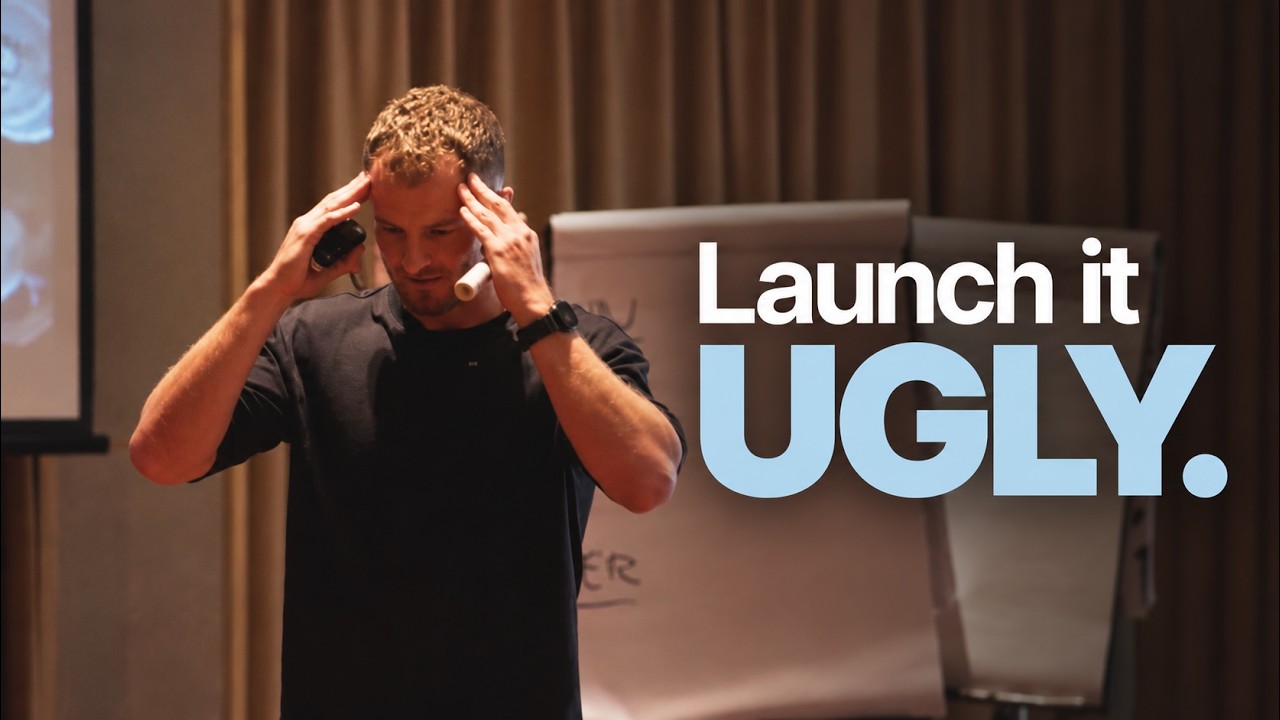
Everyone told you to slow down and make it perfect. And if you believed them, you are probably still waiting to publish something you started six months ago.
The quantity over quality lie is one of the most expensive beliefs in the expert and creator world. It sounds humble, even admirable — "I only put out my best work." But what it usually means in practice is paralysis dressed up as standards. It means the funnel that was "almost ready" four months ago is still sitting in a Notion doc. It means the offer you haven't launched because you haven't figured out the perfect price point. It means another month goes by and the market has given you exactly zero feedback because you gave it nothing to respond to.
I broke this down on camera — the full video is below — because this belief personally cost me more emotional energy than almost anything else in my business. And the story that finally cracked it open for me is not mine. It's older than that.
The Pottery Class That Rewired How I Think About Output
An art teacher splits his class in two. Group A is told they will be graded on quantity — at the end of the month, all their ceramic work will be weighed on a scale, and the heaviest pile wins. Group B is told to focus entirely on quality. One perfect piece. Research the technique. Master the method. Understand the craft at a deep level before touching the clay.
Thirty days later, something unexpected happens. The best individual pieces — the ones with real artistry, the ones worth keeping — came almost entirely from Group A. The group that was just making. Shipping. Failing. Adjusting. Making again.
Group B had been thinking. Planning. Perfecting in their heads. And when they finally sat down to make the one great piece, they had no reps behind it. No muscle memory. No real-world feedback baked into the clay.
When I heard that story, something clicked. I had been running Group B's strategy in my own business for years. And I had the emotional scars to show for it.
Why Perfectionism Feels Like Professionalism (But Isn't)
Here is the thing about the quantity over quality lie: it does not feel like a lie when you are inside it. It feels responsible. Caring about quality feels like you have standards. It feels like you are protecting your reputation. It feels like the right thing to do, especially if you have built real expertise over years and you do not want to be associated with anything mediocre.
But there is a version of "quality" that is just fear wearing a lab coat.
I had a client — genuinely talented, smart, capable — who had been working on a funnel for months. Every call we had, it was almost there. One more tweak on the copy. One more adjustment to the offer structure. One more week to feel ready. And underneath it, if you pushed hard enough, was not perfectionism. It was terror. Terror of launching and getting two sales instead of two hundred. Terror of the market giving honest feedback. Terror of finding out the idea was flawed.
Eventually, we launched it. He got two sales. And my response was: congratulations. That is not a failure. That is data. Now what do we adjust? What does the copy need? What does the funnel tell us? Because two sales means the thing works — it just needs iteration.
The worst possible outcome was not two sales. It was zero launches. Zero data. Zero feedback. That is what perfectionism guarantees.
What Does "Growth" Actually Look Like?
I used to believe growth was a smooth, beautiful upward curve. That if I was doing the right things, every month would be better than the last, every video would outperform the previous one, every launch would be bigger. And so every dip felt like evidence that something was fundamentally wrong — with the strategy, with me, with the whole thing.
What I know now is that growth is not smooth. It is jagged. It goes up, then sideways, then down, then sharply up again. And the people who build real businesses are not the ones who avoid the dips — they are the ones who do not let the dips stop the output. They stay in the experiment. They keep making the pottery.
The roller coaster is not a sign that something is broken. It is the shape of the actual process. And the people who can sit with that uncertainty — who can ship content on a Tuesday that gets eleven views and ship again on Wednesday anyway — those are the people who eventually find the thing that lands. Because they have more reps. More feedback. More data to work with.
The Conjecture Loop: A Framework for Radical Iteration
In science, a conjecture is essentially an educated guess. You form a theory, you design an experiment, you run it, you observe the result, and you let that result inform the next conjecture. The experiment does not have to succeed for the process to work. It just has to generate real feedback.
That is the actual framework for building a business in public. Not "publish when it's perfect." Not "wait until the funnel converts at 3%." Form a conjecture. Put the offer together. Drive traffic to it. Read what the numbers say. Adapt. Repeat. Again and again and again.
The biggest mistake I see people make is going through that loop once, getting a mediocre result, and deciding they are a failure. I know because that was me. The first funnel that did not convert felt like a verdict on my ability. It was not. It was round one of a process that takes many rounds. The failure was not the data point — the failure would have been quitting the experiment.
Radical iteration means you are running many experiments simultaneously, learning from all of them, and never treating any single data point as the final answer. The person who publishes twenty pieces of content and gets mixed results knows infinitely more about their audience than the person who published nothing while waiting to get it right.
This is what the content-as-sales-system approach is built on. Content is not a performance. It is an experiment. Every piece is a probe into the market. What lands? What gets ignored? What question does the audience actually have? You cannot answer those questions in your head. You can only answer them by putting things out and reading the response.
What Paul Actually Told Me About Content
When I first started working with Paul Counsel, I asked him the question every person asks when they are starting: how do I actually market myself? What is the process?
His answer was not what I expected. He said it comes down to three things. The quantity of content you publish. The frequency you can sustain. And the relevancy — finding something that actually connects with the people you are trying to reach. That is it. That is the whole engine.
He also told me I should be creating content every morning before breakfast. Before I had checked email, before I had looked at metrics, before I had talked myself out of it. That felt radical to me at the time, because I still believed that every piece had to be considered and polished before it went anywhere near a camera or a keyboard.
What he was really teaching me was that quality emerges through quantity. Not instead of quantity. Not as a later phase you get to once you have finished the quantity phase. Quantity is how you get to quality. The two are not opposites. One is the method by which you reach the other.
That reframe is at the heart of the Story Over Template pillar. Your story is the one thing AI cannot copy — but it only emerges through the reps. You cannot think your way to it. You have to make things, ship them, watch what resonates, and let the authentic signal get stronger through the noise of imperfect output. The instrument is in everyone's hands. The music — your actual voice, your actual story — only appears through use.
Is It Always About Volume? Here Is the Nuance
The quantity over quality lie cuts both ways, and I want to be careful here. Pure volume without learning is just noise. The pottery story works because Group A was not mindlessly throwing clay at the wall. They were making, observing, adjusting. The quantity was in service of feedback, and the feedback was in service of mastery.
If you are churning out content and not looking at what performs, what questions you are answering, what your audience is actually responding to — you are not iterating, you are just producing. The loop requires both the output and the observation. Conjecture, experiment, result, new conjecture. That cycle is what makes quantity productive rather than just busy.
The person who publishes three pieces of content a week and reads the data carefully is running a better experiment than the person who publishes twenty and never looks at the numbers. Volume matters. But volume in the context of an active feedback loop is what actually builds skill, authority, and results.
This is also why a real content marketing strategy is not just a posting schedule. It is a system for generating signal. What attracts? What connects? What converts? Those questions only get answered by the market, and only when you give the market enough material to respond to.
Proof That the Experiment Works
Evin Keane went through this process and came out of it with a $10,000 launch week and 1,222 email subscribers built through ManyChat. That did not happen because he waited until everything was perfect. It happened because he shipped, iterated, and kept going.
Tully Johns spent $20 on ads, acquired a $349-per-month client, and hit 12,000 organic views on a personal story reel. The story worked because it was his story, not a template — and he got there by putting things out and finding what resonated.
Anna Simonsson-Søndena went from roughly €300 a month living in a van to hitting €8,000 revenue days. She passed her entire prior year's revenue in two months. That kind of result does not come from one carefully crafted perfect launch. It comes from the accumulation of experiments, the willingness to let the market teach you, and the grit to keep going through the dips. See more client results here.
The pattern across every one of these stories is not perfection. It is persistence in the loop. Make the pottery. See what breaks. Make better pottery. Repeat until something extraordinary comes out of your hands that could not have come out of your head.
Where to Start If You Have Been Waiting
If you have been sitting on something — a funnel, a piece of content, an offer, a first video — the move is simple. Launch the imperfect version today and treat the result as data, not a verdict. Two sales is not a failure; it is a beginning. Eleven views is not embarrassing; it is feedback. A funnel that converts at 1% is not broken; it is telling you exactly what to fix.
Start the morning content habit Paul described. Before breakfast. Before you have talked yourself out of it. Something short, something real, something that takes a genuine question from your world and answers it plainly. Do that repeatedly, read what it tells you, and let quality emerge through the quantity. That is the actual process. Everything else is theory.
Watch the full video breakdown here: The Quantity Over Quality Lie on YouTube.
If you want to be inside a community that runs this experiment together — where you are not iterating alone — come and join us on Skool. We teach the full Digital Home workflow, the content systems, and the feedback loops that turn output into authority.
Join the BraveBrand community on Skool
Frequently Asked Questions
Is the quantity over quality lie really that widespread among experienced creators?
Yes — and it hits experienced practitioners hardest, because they have the most to protect. The more expertise you have, the more it feels like a betrayal of your standards to publish something imperfect. But that instinct is exactly what keeps skilled people invisible while less experienced competitors build audiences and income through sheer consistency.
How do you avoid producing low-quality output if you are focused on volume?
The key is treating every piece as an active experiment, not a performance. You are not publishing for applause — you are publishing to generate data. Reading the response, adjusting your approach, and feeding that learning into the next piece is what transforms raw quantity into genuine quality over time. Volume without observation is just noise; volume with a feedback loop is mastery in progress.
What is the conjecture loop and how do I apply it to my content or offers?
The conjecture loop is the scientific method applied to your business: form an educated guess about what will work, run the experiment (publish the content, launch the offer, drive traffic to the funnel), read the real-world result, and let that result shape your next attempt. The mistake most people make is treating a single failed experiment as a final verdict rather than as one round in an ongoing process.
How does the quantity over quality lie connect to the Story Over Template content pillar?
Your authentic story — the thing AI cannot replicate — only surfaces through repeated output. You cannot think your way to your genuine voice; it has to be excavated through use, through imperfect attempts, and through noticing which parts of your story actually land with your audience. The Story Over Template pillar argues that your story is the moat, and the quantity over quality lie is what prevents most people from ever discovering what their real story is.
What if I try the high-volume approach and my content performs badly across the board?
Uniform poor performance is itself valuable data — it usually points to a relevancy problem, meaning the content is not connecting with the specific questions your audience is actually asking. That is a solvable problem: narrow the focus, get more specific, and use the feedback to sharpen your conjecture before the next round. The worst outcome is always zero data, never bad data.
How much content should I be producing when starting out?
Paul Counsel's guidance, which shaped BraveBrand's entire content philosophy, is to create something every morning before breakfast — before you have talked yourself out of it. The specific format matters less than the habit and the frequency. Quantity, frequency, and relevancy are the three levers; all three need to be active for the experiment to generate meaningful feedback.

Luke Carter
Luke Carter is the founder of BraveBrand and is an authority on branding and neuromarketing that drives business growth. Say 👋 on LinkedIn!
Ready To Scale Your Brand?
Put an end to DIY branding and ineffective marketing, and start attracting premium clients with total clarity.
Let's Chat Strategy