

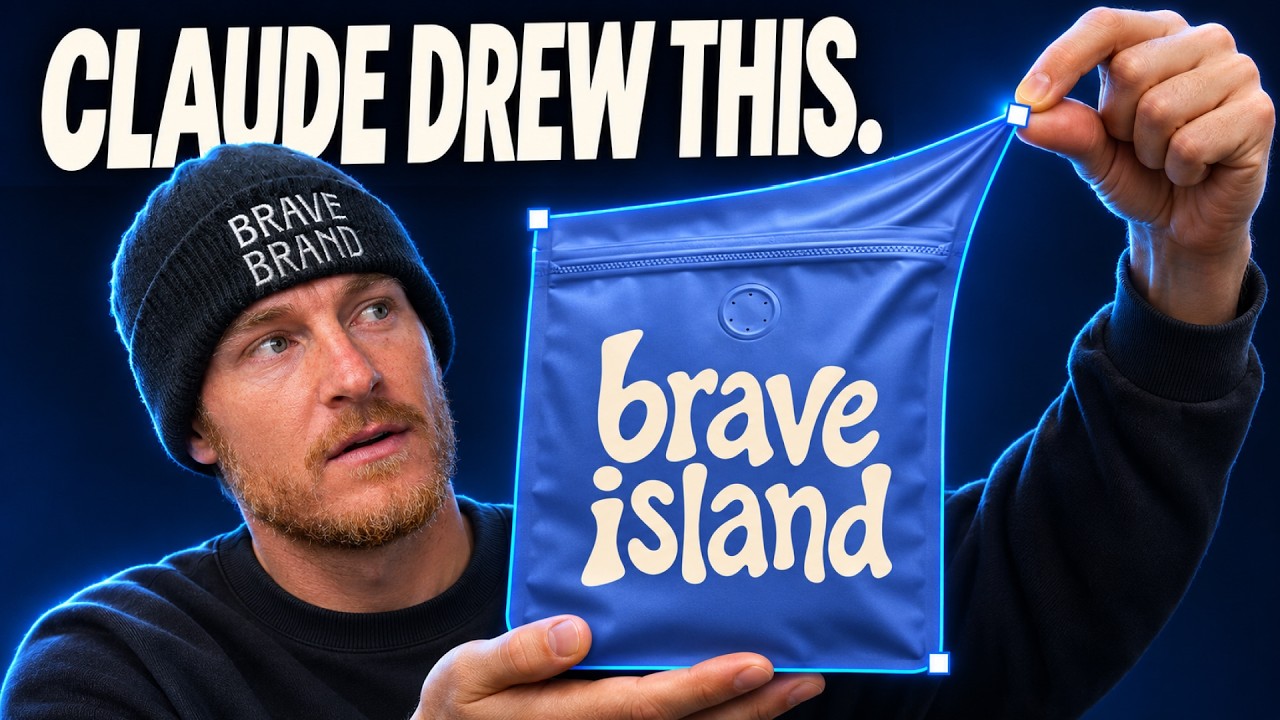
Last week I sat inside a live client brief and watched a one-person agency produce six distinct brand routes, three homepage hero sections, and a client-ready presentation deck — in under an hour. No team. No handoffs. No waiting. Just a brief, an AI design agent called Fred, and a Figma connection that let the work appear on the board in real time. The ai design workflow that changes everything is not a hypothetical. I recorded the whole thing on camera so you can see exactly how it moves.
I broke this down on camera — the full video is below.
What You Are Actually Watching in This Demo
I have been building brands for over ten years. I remember sitting in a gym lounge as a freelancer, carefully placing logo mockups onto bags and product shots in Photoshop just to give the client a rough idea of what their brand might feel like. That process took days. The iteration alone — waiting for feedback, going back into files, re-exporting — could stretch a simple identity project across three weeks before anyone had agreed on a direction.
What I showed on camera is structurally different. The agent — Fred, my graphic designer — is connected to Claude 3.5 Sonnet and to Figma via Figma's MCP server. That connection gives Fred full access to the Figma workspace: he can create new boards, draw vectors by hand, place images, and build out entire design systems without me touching the canvas. I work inside a platform called Buzz, where all my agents live, and we built a plugin that lets Figma and Buzz run inside the same interface. No tab switching. No credit burning on Figma's own AI tools when my Claude subscription already does the job.
The project I used to test this was a brand I actually want to build one day — Brave Island Coffee, a single-origin blend from Vanuatu, an island I spent a month on a few years back where I tasted some genuinely exceptional coffee. I had a brief ready, a Pinterest reference board full of sky blues and earthy tones and illustrated animated vibes, and a brand playbook our brand strategist had prepared beforehand. Fred ingested all of it. Then I pressed go.
Why Speed Alone Is Not the Point Here
Before I walk through what happened, I want to address the obvious objection — because I know it is coming. Some of you will look at the initial outputs and call it slop. The first three roots Fred produced were rough. One typeface looked uncomfortably close to Comic Sans. One color palette felt tacky. I would not have put any of them in front of a client unedited. That is not the point.
The point is that in the time it used to take me to open a brief and choose a typeface, I had six distinct creative directions on a board, all informed by the actual research and positioning from the brand playbook. The job had moved from a blank canvas to a curation problem. And curation is where ten years of taste lives. That is irreplaceable. That is what the client is actually paying for.
This is the argument the Story Over Template pillar has always made: AI is the instrument everyone now has access to. Your story, your taste, your judgment — that is the music only you can write. Fred can generate a logo mark. Fred cannot tell you that the holiday shirt wild card direction is secretly the strongest of the six because it carries a warmth that fits the brand's origin story. That call is yours. And making that call confidently, backed by a decade of pattern recognition, is worth every dollar a premium client spends.
The ai design workflow that changes everything is not about replacing the designer. It is about compressing the mechanical parts of the process so the human judgment parts — the parts that cannot be automated — get more time, more weight, and more room to breathe.
How the Workflow Actually Runs, Step by Step
Here is the sequence as it played out in the demo, tidied up for a reader who wants to replicate it.
Start with a proper brief. This is non-negotiable. Fred is trained to look for a brand playbook and Pinterest references. The brief I gave him included the purpose of the project, the most important outcome, the main idea, and what I needed from him specifically. A job is as good as its brief — garbage in, garbage in, whatever speed you are running at. The brand playbook, which our strategist prepared beforehand, gave Fred the positioning language and the research so he could make informed creative decisions rather than generic ones.
Generate three distinct brand roots. The first prompt asked Fred to produce three directions with logo exploration, image style references, and initial mockups. He placed the reference images and logos directly onto the Figma board — something that would have taken a junior designer an afternoon — and produced three routes in one pass. Claude's ability to hand-draw vector elements is what made this feel genuinely different from earlier AI image tools. These are not generated rasters. They are actual vectors Fred draws directly into Figma.
Give specific directional feedback. I did not say "make it better." I shared a Figma link to a specific reference pin and told Fred exactly what I disliked and what I wanted him to draw from. Option three's typeface needed to go. I wanted one ultra-simplified direction and one wild card that pulled color from the reference board. Two more routes appeared on a new board while I was still typing the next thought.
Select and redraw. From six routes I landed on three: Route One, Route Six (Plain Sailing), and the holiday shirt wild card. I gave Fred the green light to do proper redraws — tightening the vectors, refining the icon sets, adding the Brave Brand mark where it fit. The redrawn versions came back as full client-presentation-ready assets. All vectors. All organised on the board.
Mock up the hero sections. Before presenting, I wanted to show UX application — three homepage hero variations per route. Fred produced nine hero sections in roughly two minutes. Some had legibility issues I would fix. But the client can see the brand living in context, which closes the imagination gap that kills so many early-stage brand presentations.
Package for the client. Fred's training includes BraveBrand's end-to-end brand presentation process. He assembled the routes into a deck — route name, rationale, mockups, color and type information — formatted to the standard we use for high-ticket clients. The result looked premium. A few tweaks, and it goes out the door.
What Does This Actually Cost the Client?
The client brief I was replicating this from was a real one. They paid six thousand dollars for a brand refresh and a new website. That is not commodity pricing. That is not logo-and-colors pricing. That is transformation pricing — and the difference matters.
If you are selling a logo, you are selling a deliverable. Someone can replicate the deliverable, run the same workflow I just showed, and undercut you on price. The floor on that work is now very close to zero. That is not a threat to manage. It is a fact to price around.
What clients pay real money for is the confidence that they will get from where they are now — stuck, invisible, dissatisfied with how their brand represents them — to where they want to be, which almost always comes down to more revenue, more visibility, and more loyal customers. The brand identity is a component of that journey. The website is a component. The CRM and the revenue system are components. When you sell the whole journey, you stop competing in the commodity space entirely.
That is what the ai design workflow that changes everything actually enables: not faster logos, but a faster path to a whole brand system you can charge premium rates for — because you are selling the outcome, not the asset.
The parallel to what genuine brand differentiation looks like for service businesses is direct here. The designers who will get squeezed are the ones selling a deliverable. The ones who will grow are selling the result the deliverable produces.
Is This Real Proof or Just a Demo?
I want to be specific about the proof here, because "I built this in an hour" claims are everywhere and most of them are staged.
The six-thousand-dollar client brief existed before the demo. I discovered this workflow while working on that live brief the day before I recorded the video. The deck I showed as a finished example — a detailed brand guidelines document produced for a recent high-ticket client — is a real client deliverable, not a prop. Fred's training is built on BraveBrand's actual end-to-end brand processes, the same ones we use on clients at the six and seven figure level.
BraveBrand currently runs at £67,408 in gross monthly volume, with an Operator agent filing morning and weekly growth reports on a cron, and an email engine that sent over a thousand emails in seven days at around 36% open rate. The crew being sold inside the community is the crew running a live agency. That is auditable. That is not a promise about what AI might do — it is what it is already doing.
Results like Anna Simonsson-Søndena going from €300 a month living in a van to €8,000 revenue days did not come from a faster design tool. They came from a complete system: positioning, brand story, digital infrastructure, and the confidence to charge for the outcome rather than the output. The workflow I showed is one piece of that system. The piece that used to take weeks now takes an hour. The rest of the system is what turns that hour into a premium deliverable a client happily pays five to ten thousand dollars for.
You can see client results that go a lot deeper than a sixty-minute brand build.
The 99% That AI Cannot Do
Here is what I said on camera and I want to repeat it in writing because it is the thing most people miss when they watch a demo like this.
The job is now 99% art direction and 1% technical. That ratio used to be reversed. The technical execution — drawing the vector, placing the mockup, formatting the deck — consumed most of the time. What remained for creative direction was a sliver squeezed between client calls and file management. Now the technical part collapses to almost nothing. The art direction part — the taste, the judgment, the ability to look at six routes and know that the wild card is secretly the strongest — that expands to fill the space.
That is not AI replacing the designer. That is AI doing what Photoshop did in the nineties: collapsing the mechanical ceiling so craft can rise. The designers who called Photoshop cheating are not the ones who built agencies. The designers who learned to use it faster and better than anyone else are.
This is the same transition. Your AI output does not have to look like AI — but it will if the person behind the tool has not developed the taste to redirect it. That taste is built over years. It is not in the prompt. It is in the person giving the prompt. And it is the thing clients are actually buying when they hand over six thousand dollars for a brand project that takes under an hour to present.
The ai design workflow that changes everything is not a shortcut that removes the need for expertise. It is a force multiplier for expertise you already have. If you are technically fluent, have a decade of pattern recognition, and have been frustrated by how slowly the mechanical parts of your process move — this is the tool that closes that gap.
How to Get Access to Fred and the Figma Plugin
Fred the graphic designer agent is available inside the BraveBrand Skool community. When you join, the Figma plugin for this exact workflow is pinned at the top of the community so you can test it immediately on a free trial. Fred runs on Claude, is connected to the Buzz platform, and comes pre-trained on BraveBrand's brand strategy and design processes from end to end — so you are not starting from a blank system prompt, you are getting an opinionated agent that already knows how premium brand work is supposed to look.
The broader system the community teaches is the Digital Home: a fully functional front end and back end built on code you own, with a CRM connected, designed to take payments and generate recurring revenue. The agents — Fred included — help you build that entire setup. No platform subscription once it is built. The site is yours for life. The next video in this series covers building out the rest of the Brave Island Coffee site and connecting the CRM — so if you want to follow the full build, that is where it goes next.
Watch the full workflow walk-through at youtube.com/watch?v=OpSrPiRb3SA and then come and get the tools to replicate it.
Join the BraveBrand community on Skool — the Figma plugin and Fred the agent are waiting for you at the top of the feed on a free trial. Come and test it.
Frequently Asked Questions
What exactly is the AI design workflow that changes everything — is it just faster Canva?
No. The ai design workflow that changes everything runs a trained AI agent called Fred directly inside Figma via an MCP server connection, which means it draws real vectors, creates new boards, and builds client-ready decks — all without you touching the canvas. Canva and similar tools require you to do the building. This workflow requires you to do the directing.
Do I need to know how to design to use this?
You need to know what good looks like — which is taste, not technical skill. Fred handles the execution; you handle the judgment calls: which route is strongest, which typeface is wrong, which direction serves the client's outcome. If you have been in design or branding for a few years, you already have the most important part.
What platforms do I need to run this workflow?
You need a Figma account, access to the Buzz platform where the agents live, and a Claude subscription — Fred connects to Claude directly, so you are not burning Figma's own AI credits. The Figma plugin that links Buzz and Figma into one interface is available free when you join the BraveBrand Skool community on a trial.
How does this workflow justify premium pricing to a client?
Speed of production is not what you are charging for — you are charging for art direction, strategic positioning, and the ability to get the client from stuck and invisible to visible and revenue-generating. The workflow compresses the mechanical parts so your judgment and expertise can shine; a client paying six thousand dollars is paying for the outcome, not the hour count.
Is the ai design workflow that changes everything only useful for brand identity work?
The demo covers brand identity and homepage hero sections, but the same agent and Figma connection extend to full web design mockups, brand guidelines documents, and CRM-connected digital builds — the next phase of the Brave Island Coffee project covers exactly that. The workflow is a foundation for selling a complete brand system, not just a logo deliverable.
What stops a client from doing this themselves and cutting me out?
The same thing that stopped them building their own website in Dreamweaver in 2005: they can access the tool, but they do not have the taste, the positioning knowledge, or the systems thinking to get to a result worth having. Your value is not access to Fred — it is knowing what to do with Fred, and knowing what the brand needs to do commercially once it exists.

Luke Carter
Luke Carter is the founder of BraveBrand and is an authority on branding and neuromarketing that drives business growth. Say 👋 on LinkedIn!
Want To Build This Yourself?
The Digital Village is where founders build their own brand and AI systems next to other people doing the same. It runs on Skool for $14 a month.
Join The Village