
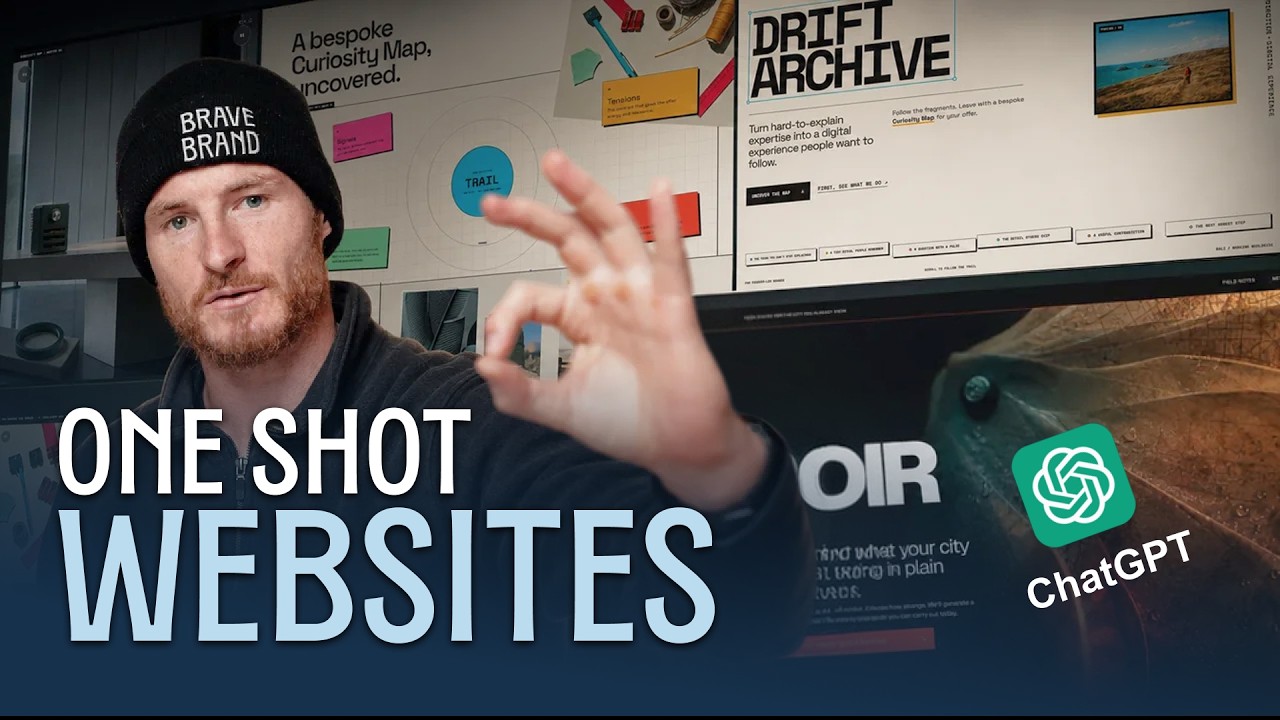
Six fully functional websites. Fourteen minutes. One AI model. I built 6 websites in 14 minutes with GPT-5.6 Sol — and I did it live, on camera, no cuts, no prep work hidden off screen. I broke this down in detail so you could watch every prompt, every output, every site go live in real time. The full video is below.
Watch: I Built 6 Websites in 14 Minutes With GPT-5.6 Sol
Now here's the thing. The moment I posted that video, the comments lit up. Coaches, consultants, freelancers — all saying some version of the same thing: "Okay, but if I can build a site in 14 minutes, so can my competitor. So can my client. So can literally everyone. What does that actually mean for me?"
That's exactly the right question. And the answer is what this whole article is about.
Because the speed demo isn't the point. The point is what it reveals about where the real competition is happening now — and why most experts are competing in the wrong arena entirely.
Why Does Everyone Feel Invisible Even When They're Clearly Talented?
Here's the pain most experts carry around like a backpack full of bricks. You're genuinely good at what you do. You've got results. You've got happy clients who'd vouch for you in a heartbeat. But online? You're a ghost. You post content and it vanishes into the void. You pitch and it feels desperate. You watch people with half your experience getting three times your attention, charging twice your rates, and somehow always fully booked.
And now AI enters the chat. And instead of making things feel simpler, it quietly drops this terrifying thought into your head: if anyone can build a website in 14 minutes, if anyone can generate blog posts in seconds, if anyone can spin up a funnel before lunch — then what exactly is my edge?
That anxiety is real. I hear it constantly inside the BraveBrand community. "Luke, I don't want to sound like a generic ChatGPT output." "I feel like AI is going to commoditize everything I've built." "How do I compete when the barriers to entry are basically zero now?"
These aren't weak questions. They're smart ones. And they deserve a straight answer, not a motivational poster.
What They've Already Tried (And Why It Hasn't Fixed the Problem)
Most experts facing this problem go one of two directions. They either embrace the speed tools wholesale — building faster, posting more, automating everything they can touch — or they resist AI entirely and try to compete on "authentic human connection," as if hand-written captions are going to out-muscle a well-trained content system.
Neither works. Here's why.
The post-more strategy just makes the noise louder. You're not standing out by doing more of what everyone else is doing faster. You're becoming part of the blur. Six websites in 14 minutes means your competitor can also do six websites in 14 minutes. Fourteen minutes of output means nothing if the strategy behind it is hollow.
The resist-AI strategy is worse. You're choosing to compete with a slingshot against people using artillery. The tools exist. Pretending they don't just means you're slower and not meaningfully more human.
The real mistake — the one almost everyone makes — is thinking the competitive arena is still the product or the service. It's not. It hasn't been for a while. But AI just made that undeniable.
The Reframe: The Castle Is Free. Build the Moat.
Here's the framework I keep coming back to, and it's the one that underpins everything BraveBrand does: The Moat.
GPT-5.6 Sol just handed everyone a free castle. Six websites in 14 minutes. A landing page, a sales funnel, a blog, an automation sequence — all of it, built faster than you can drink a coffee. The castle is free. Anyone can have one. And that's exactly why the castle is worthless as a competitive advantage.
What can't be copied? What can't be generated in 14 minutes? What AI cannot, no matter how fast it gets, produce on demand?
The moat.
The moat is your marketing. It's your positioning. It's the story that makes someone feel like you're the only logical option. It's the authority you've built in a specific place, for a specific person, solving a specific problem — articulated so clearly that when a stranger lands on your site, they don't think "oh, another coach." They think "this person gets it. This is the one."
AI made products copyable overnight. It did not make you copyable. It cannot replicate your positioning, your client stories, your specific point of view, the particular combination of experience and worldview that makes your take on your niche yours alone. That's the moat. And most experts have never built it — not because they can't, but because they've been too busy building the castle.
"It doesn't matter how good your product is. It matters how your marketing works."
That's not a dismissal of quality. It's a recognition of reality. Marketing is the new moat. It always was — AI just made the gap between those who have it and those who don't catastrophically visible.
So What Does the Moat Actually Look Like?
Let me get specific, because vague strategy is useless. The moat has four components that I see working over and over inside BraveBrand's client work.
First: one-sentence positioning. Most experts cannot complete this sentence cleanly: "I help [specific person] solve [specific problem] so they can [specific outcome]." Not a paragraph. Not a list of services. One sentence. If you can't say it, your audience can't remember it. If they can't remember it, they can't refer you. If they can't refer you, you're stuck doing cold outreach forever. Write the one sentence that makes you the only option for your specific person.
Second: a story that can't be copied. I call this The Instrument and the Music. GPT-5.6 Sol is the instrument. Everyone has it now. The music is the story only you can write — the case study from your specific client, the failure you turned into a method, the moment your perspective shifted. An AI cannot generate that from scratch because it never lived it. Your job is to put that story in your content consistently, so the instrument serves the music instead of replacing it.
Third: owned ground. This is the Digital Home principle. Social media is rented land. Your posts live on someone else's platform, subject to algorithm shifts, account bans, reach throttling. When the platform changes the rules — and it will — you lose access to your audience overnight. The moat requires owned infrastructure: your site, your email list, your knowledge graph that AI search engines can find and cite. You cannot build a moat on rented ground. You need to be the homeowner, not the tenant. If you want to go deeper on this, read our breakdown of brand strategy in the AI search era — it covers exactly how visibility is shifting and what owned infrastructure actually means in 2026.
Fourth: content that converts, not just content that exists. The mistake is producing content and measuring it by volume. Six websites in 14 minutes is impressive volume. But volume without a conversion architecture — an Attract, Connect, Convert system where each piece of content has a specific role — is just noise. Every piece of content should do one of three things: get you found by new people, deepen trust with people who've already found you, or move someone toward a decision. If you can't tell which one a piece of content is doing, it's doing none of them. Here's our deep dive on why content doesn't convert and how to fix the funnel — worth a read if you're posting regularly but not seeing leads.
What Happens When the Moat Is Built? Real Numbers From Real People.
I want to give you proof this isn't theory, because it's easy to dismiss frameworks until you see what they produce.
Anna Simonsson-Søndena was living in a van making roughly €300 a month when she started working with BraveBrand. She built her moat — clear positioning, a story only she could tell, owned infrastructure, a content system that converted. She had €8,000 revenue days. She passed her entire previous year's revenue in two months. The product didn't change. The marketing did.
Adne Støyva increased his prices 2.5 times — from €200 to €490 per month — and started getting clients joining organically. Not because he got dramatically better at his craft between those two price points. Because his positioning finally communicated the value he already had.
Evin Keane launched at $10K in a single week. Tully Johns spent $20 on ads and landed a $349/month recurring client off a personal-story reel that hit 12,000 organic views. The Bali Time Chamber went from 7,697 Instagram followers to 1.2 million and from zero to over $100K per month in six months. Zero paid ads. Pure moat.
You can see client results in full detail here — the numbers, the timelines, what actually changed.
None of these results came from building faster websites. They came from building better marketing systems around the expertise that was already there. The castle was already standing. They built the moat.
How to Use Speed Tools Without Becoming Commoditized
So where does GPT-5.6 Sol actually fit? Let me be direct: use it. Use it hard. Building 6 websites in 14 minutes is a genuine superpower for the expert who already has a moat — because it means you can execute at a speed that would have taken weeks a year ago. The tool amplifies the strategy. Without the strategy, it amplifies the noise.
Here's how I think about it. The speed tools handle the castle — the infrastructure, the copy frameworks, the structural build. But every output still needs to run through your Brand Wiki: the compiled intelligence layer of your specific positioning, your client stories, your frameworks, your voice. When your story is feeding the AI, the output sounds like you. When it's not, it sounds like everyone else.
This is the Brand Wiki principle. It's why AI-native brand intelligence is becoming the most valuable asset an expert can build — because it's the thing that makes every AI output carry your moat instead of erasing it. The Brand Wiki is the product. The websites, the funnels, the content — those are just views on top of it.
Use the speed. Feed it with your story. That's the move.
The One Action That Changes Everything
Here's the specific next step, because I said I'd always end on one. Write the sentence. Not a paragraph. Not a mission statement. One sentence: "I help [specific person] solve [specific problem] so they can [specific outcome]." Put it in front of five people who aren't in your industry. If they all say "oh, I know exactly who you work with" — you've got a moat starting. If any of them look confused — go again. That confusion is costing you every day it stays unresolved.
The speed tools will keep getting faster. GPT-5.6 Sol is not the ceiling. There will be another model, another demo, another "I built X in Y minutes" moment — and the castle will get cheaper every single time. The moat only gets more valuable. Build it now.
Ready to Build the Moat?
If this landed, the next step is to come inside the community where we teach the full Digital Home workflow — positioning, content systems, owned infrastructure, and the Brand Wiki that makes AI work for your brand instead of against it. It's free to start and the conversation in there is worth the price of entry alone.
Join the BraveBrand community on Skool and let's build the moat together.
Or if you'd rather watch first, go back to the video at the top of this article — I built 6 websites in 14 minutes with GPT-5.6 Sol live on screen, and I walk through exactly what the speed means and what it doesn't: watch it here on YouTube.
Frequently Asked Questions
What is GPT-5.6 Sol and why does it matter for building websites?
GPT-5.6 Sol is OpenAI's latest model release, significantly more capable than its predecessors at generating structured code, design instructions, and deployment-ready content in a single pass. It matters because the barrier to producing functional websites is now effectively zero — which changes where the competitive advantage actually lives for service businesses and experts.
When you say you built 6 websites in 14 minutes with GPT-5.6 Sol, does that mean the sites are actually live?
Yes — fully functional, deployed sites, built live on camera with no hidden prep work. The video documents every prompt and every output in real time. The point of the demo isn't to show off the tool; it's to show how dramatically the infrastructure cost has collapsed and why that forces a rethink of where your marketing energy should go.
If anyone can build sites this fast, how do I compete?
You compete on the moat, not the castle. The castle — the website, the funnel, the content templates — is now essentially free and replicable by anyone. The moat is your positioning, your story, your authority in a specific niche for a specific person, and your owned audience infrastructure. That's the part AI can't generate because it requires your lived experience and deliberate strategic choices.
Do I need a Brand Wiki before I start using AI tools to build my marketing?
Not before you start, but you need one before you scale. Without a Brand Wiki — the compiled intelligence layer of your positioning, stories, and frameworks — every AI output you produce sounds generic, because the AI has no specific information to draw from. The Brand Wiki is what makes the speed tools produce output that sounds like you and serves your moat instead of commoditizing it.
Is this approach only for people who are already tech-savvy?
Not at all. The most important work in building a moat is strategic and story-based, not technical. Knowing your one-sentence positioning, your client stories, and your specific framework is more valuable than knowing how to code. The tools handle the technical execution — your job is to feed them with something worth building on.
What's the first thing I should do after reading this?
Write the one sentence: "I help [specific person] solve [specific problem] so they can [specific outcome]." Test it on five people outside your industry. If they can immediately picture who you work with and why someone would choose you, your moat has a foundation. If they look uncertain, that confusion is the most expensive problem your business has right now — and fixing it costs nothing but clarity.

Luke Carter
Luke Carter is the founder of BraveBrand and is an authority on branding and neuromarketing that drives business growth. Say 👋 on LinkedIn!
Want To Build This Yourself?
The Digital Village is where founders build their own brand and AI systems next to other people doing the same. It runs on Skool for $14 a month.
Join The Village