

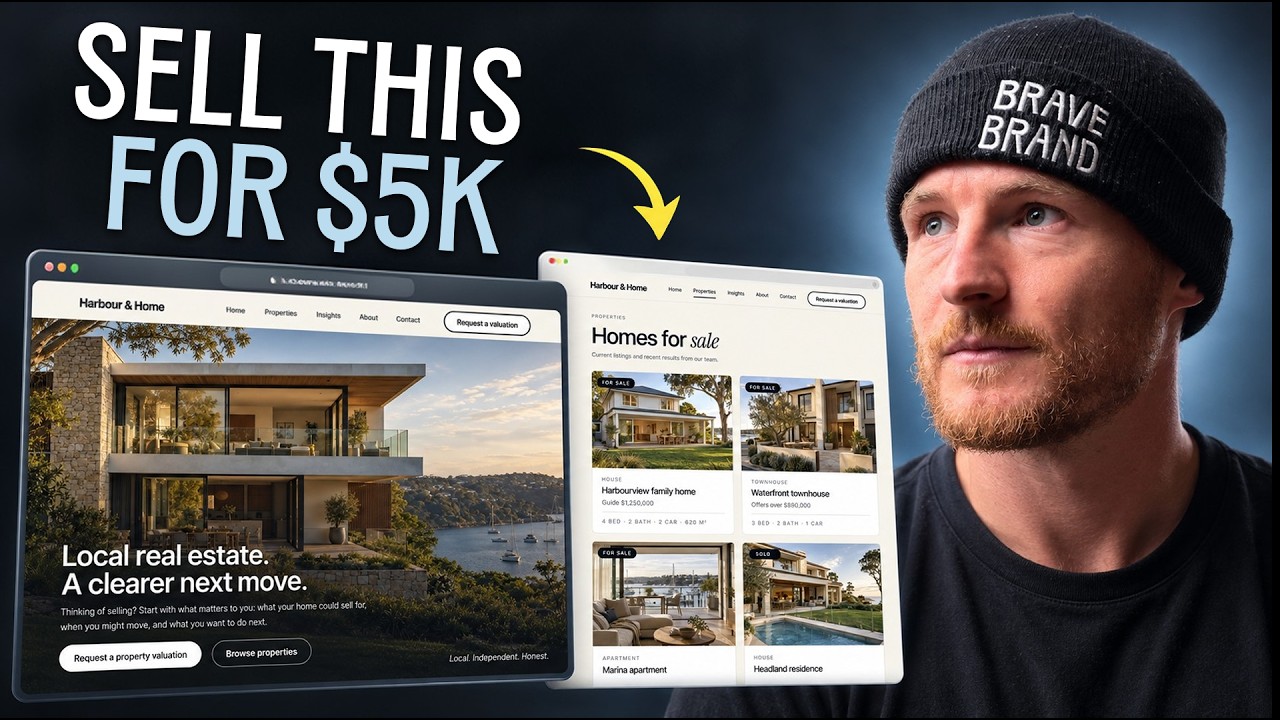
One hour. One person. A complete website and CRM that the client owns outright, no monthly platform fee eating into their margin, no landlord who can lock them out of their own data. I built a full website and CRM with AI in 1 hour — and I recorded the whole thing on camera so you can see exactly how it happened. No edits, no cuts, no pretending the hard bits were easy.
I broke this down on camera — the full video is below. Watch it and you will see every prompt, every decision, and every place where the AI surprised me. But if you would rather read, this article covers the same ground in full. You do not need to press play to walk away with a working understanding of the process.
Watch: I Built a Full Website + CRM With AI in 1 Hour
Before I get into the how, I want to be honest about why this matters — because it is not what most people think when they see a headline like this.
The Problem Is Not That You Build Too Slowly
If you are a web designer, a developer, or a one-person agency, you have probably already felt the squeeze. The rates for mid-tier website builds are compressing. Clients show up with Canva mockups and ChatGPT copy and ask you to "just finish it off." You are being asked to polish AI output for scraps — and if you are honest, you know that is not where you planned to be when you went independent.
The instinct is to get faster. Ship more. Use AI to cut build time down and win on volume. That logic is understandable, but it is exactly backwards. Speed without a system produces exactly the kind of mixed results you cannot hand to a paying client with confidence. You end up building more but charging less, which is the race to the bottom dressed up as efficiency.
The real problem is not pace. The real problem is that most of what you are building does not belong to the person paying for it. They are renting. You are renting it for them. And neither of you knows it until the platform changes its terms, raises its price, or locks them out of their own contact list. That is the moment the whole thing detonates — and by then it is too late to do anything about it.
A Ramp study from February 2026 found that freelance platform spend had collapsed from 0.66% of company budgets to 0.14% between 2022 and 2025. The money did not go to cheaper freelancers. It went to AI subscriptions. The bottom of the market has already evaporated. The builders who are still doing well are the ones charging $5,000 to $10,000 for premium work — structured, secure, and built so the client actually owns what they paid for.
Why the Usual Fixes Do Not Work
Most independents respond to rate compression the same way: they switch platforms. GoHighLevel feels like the answer for about six months. Then the price goes up and the features change and you discover that every contact your client has ever collected lives on someone else's server. Moving to Squarespace or Wix shifts the landlord but not the tenancy. The client still does not own anything. They are paying monthly rent forever on an asset they will never hold outright.
The other common move is to go harder on AI output. Generate faster, deliver more, undercut the competition on turnaround time. The problem there is that fast AI output with no system behind it is exactly what clients mean when they complain about generic content and cookie-cutter sites. You end up second-guessing everything you ship because you cannot confidently answer a client's technical questions about your own build. So you either undercharge to avoid scrutiny or you do not sell it at all.
Switching platforms is changing the landlord, not ending the tenancy. And shipping more AI output faster without a system just multiplies the problem. Neither fix touches the actual gap, which is ownership.
The Real Problem Is Who Owns the Ground
Here is the reframe that changes everything. The Sovereignty Ladder goes like this: renting, then capturing, then owning the list, then owning the home, then sovereign. Most business owners — and most of their clients — are stuck at step one. They are renting. They are paying monthly to live on someone else's land, and they will never own the building no matter how long they stay.
A Digital Home is different. It is a site the client owns outright. The code is theirs. The data is theirs. The contacts are theirs. The monthly platform fee stops, and if they ever want to leave, they take everything with them. That is not a feature. That is the entire point. You cannot build a real business on rented ground — and the moment your client discovers they cannot export their own data is the moment they realise how exposed they have been all along.
This is the framework I call Own Your Home. The castle is built for you for free — every platform in the world will give you a website and a CRM and a funnel builder. The moat is what you have to build yourself. Ownership is the moat. When I built a full website and CRM with AI in 1 hour, I was not just saving time. I was building something the client could keep, move, or sell. That is the difference between a $500 build and a $5,000 build — not the hours, the durability.
What I Actually Built and How I Built It
The stack I used is the one BraveBrand runs on: Next.js 15 on the front end, Cloudflare Workers for the backend, Supabase for the database, and Claude Code doing most of the heavy lifting on the build itself. This is not a drag-and-drop website. It is production-grade infrastructure that a developer could audit and a client could hand to any other developer in the world without being locked to a proprietary system.
Here is how the hour broke down in practice.
The first fifteen minutes were positioning. Before I wrote a single line of code or prompted the AI on anything visual, I put the client's one-sentence positioning statement into the Brand Wiki — who they are, who they serve, what problem they solve, and what makes them the only option. The Brand Wiki is the intelligence layer. Everything the AI builds after that is downstream of it, which means the site actually sounds like the client instead of sounding like a template everyone else is using.
The next twenty minutes were the build itself. I gave Claude Code the Brand Wiki, the page structure, and a set of component briefs. It scaffolded the entire site — home page, about, services, contact — with copy that was already positioned correctly because the brief was already correct. I was not prompting into the void. I was directing a capable builder who already knew the client's voice.
The CRM took about fifteen minutes on top of that. Supabase handles the database. The contact forms push directly to it. No third-party platform sitting between the client and their own lead data. Every person who fills out a form goes straight into a table the client can export, query, or migrate at any point. That is the part most platforms will never let you do without a fight.
The last ten minutes were deployment. Cloudflare Workers means the site lives at the edge — fast everywhere in the world, cheap to run, and completely under the client's control. No hosting bill from a vendor who can raise prices next quarter. The domain points to something they own.
The whole thing is open-source. The code costs nothing to run. The moat is the Brand Wiki feeding it — and that is mine to build with them, which is why I can charge for it.
What This Means for Your Rate
When you can build a full website and CRM with AI in 1 hour using a repeatable system, two things change at once. Your capacity goes up — you can take on more clients without working more hours — and your justification for a premium rate gets stronger, not weaker. The client is not paying for your time. They are paying for the outcome: a site they own, a CRM they control, and a build they could hand to any developer in the world without being held hostage to a proprietary platform.
That is worth $5,000 to $10,000. Not because the hours justify it, but because the alternative — staying on GoHighLevel or Squarespace and paying monthly rent forever — costs more over three years than the build does in week one. The maths does the selling for you, once you can frame it.
This is how the Long Sword works. The short sword is direct outreach, DMs, proposals — cash now. The long sword is the system you build once and sell repeatedly. When your build process is this tight, every client you deliver it to is also a case study that makes the next pitch easier. AI has split the market into two groups: builders who deliver commodity output fast, and builders who deliver ownership-grade work at a premium. One of those groups is under pressure. The other is not.
What Happens When the Client Tries to Leave a Platform
I want to tell you a story that is not mine, because it is the one that closes more conversations than any case study I have ever shared.
A business owner builds their entire operation on GoHighLevel — contacts, automations, funnels, everything. Three years in, the platform changes something that breaks a core part of their workflow. They want out. They go to export their contact list and discover that the export is limited, the automations are proprietary, and the funnel builder does not produce code they can move anywhere. Three years of work is effectively stranded. This is not a hypothetical. It is documented on GoHighLevel's own community board, hundreds of threads deep, by real business owners who had no idea the exposure existed until they tried to leave.
The moment a business owner discovers they cannot export their own data is an acute emotional event. It is the moment tenancy becomes real to them. When you can walk into that conversation offering a Digital Home — something they own outright, something they can move or sell, something with no monthly platform fee — you are not selling a website. You are selling the end of that exposure. That is a different conversation entirely, and it commands a different rate.
BraveBrand itself runs on this exact stack. The Operator agent files morning and weekly growth reports on a cron. The email engine sent 1,036 messages in seven days at around 36% open rate. The backend worker runs on a five-minute cycle. Everything is auditable, everything is owned, and everything is built on open-source infrastructure that no vendor can take away. See client results from the builders and founders we have worked with — the pattern is the same every time: ownership creates confidence, and confidence creates premium rates.
Anna Simonsson-Søndena went from roughly €300 a month living in a van to €8,000 revenue days after getting the system and the positioning right. Jeff Wagner cleared $25,000 net in 30 days, mostly while on holiday. The system kept running when he was not at his desk — which is the point. The month stops depending on you personally when the infrastructure is solid enough to carry itself.
Is This Replicable Without a Deep Technical Background?
Yes, with one honest caveat. The build I described is not a drag-and-drop exercise. Next.js, Cloudflare Workers, and Supabase require you to be comfortable with code at a conceptual level — you do not need to be writing every line from scratch, because Claude Code handles most of that, but you do need to understand what is being built well enough to direct it and to answer a client's questions about it.
The good news is that the primary audience for this is not beginners. In BraveBrand's own research, "not technical" was the least-common blocker among independents — seven of sixty-six respondents named it. What most capable builders lack is not skill. It is structure. A repeatable system with a proven stack means you stop making architecture decisions from scratch on every project and start deploying something you already know works. The right AI tools do not replace your technical judgment — they amplify it, so you can do in an hour what used to take a week.
The Brand Wiki is the part that requires genuine attention regardless of technical level. Getting the positioning right before the build starts is what makes the output client-ready instead of generic. That is where the hour is really earned — not in the scaffolding speed, but in the clarity that feeds it.
How to Take the Next Step
If you want to see the full build in real time — every prompt, every decision, every place where the AI did something unexpected — the video is at youtube.com/watch?v=q_jbUFiXPSA. Watch the whole thing. It will show you more about what this process actually feels like than any written walkthrough can.
If you want to go deeper — to get the full system, the Brand Wiki methodology, the agent stack, and the community of builders doing this work every day — the place to start is below.
Join the BraveBrand community on Skool and come and build alongside people who are already doing this. The Digital Home workflow is taught inside, the agent playbooks are there, and the community is full of technically fluent independents who are building ownership-grade work and charging accordingly. It is free to start. Come and see what a Digital Home actually looks like from the inside.
Frequently Asked Questions
Can you really build a full website and CRM with AI in 1 hour?
Yes — if you have the positioning done in advance and a repeatable stack you already know. The hour I recorded covers a complete Next.js site with Supabase-backed CRM, deployed on Cloudflare Workers. The speed comes from the system, not from cutting corners on quality.
What stack did you use for this build?
Next.js 15 for the front end, Cloudflare Workers for the backend, Supabase for the database, and Claude Code to handle the bulk of the scaffolding. All open-source, all client-owned, with no proprietary platform sitting between the client and their data.
Is this approach suitable for non-technical freelancers?
It requires comfort with code at a conceptual level — you need to be able to direct the AI and answer client questions about the build. In BraveBrand's own research, technical skill was the least-common blocker among independents. What most people need is structure, not more skill.
Why does ownership matter more than the build speed?
Because when I built a full website and CRM with AI in 1 hour, the hour was not the value — the fact that the client owns the output outright is the value. Platforms like GoHighLevel and Squarespace trap clients in monthly fees with no clean exit. An owned Digital Home has no landlord and no lock-in, which is what justifies a $5,000–$10,000 rate instead of a $500 one.
How is this different from building on GoHighLevel or Squarespace?
Those platforms own your client's data and charge rent in perpetuity. When your client tries to leave, they often cannot take their contact list, their automations, or their funnel structure with them. A Digital Home built on open-source infrastructure is fully portable — the client can move it, sell it, or hand it to any developer in the world.
What is the Brand Wiki and why does it matter before the build starts?
The Brand Wiki is the intelligence layer — a compiled set of positioning documents that tells the AI who the client is, who they serve, and what makes them the only option. Building without it produces generic output that sounds like every other AI-built site. Building with it produces copy and structure that already reflects the client's voice, which is what makes the output client-ready instead of something that needs to be polished for scraps.

Luke Carter
Luke Carter is the founder of BraveBrand and is an authority on branding and neuromarketing that drives business growth. Say 👋 on LinkedIn!
Want To Build This Yourself?
The Digital Village is where founders build their own brand and AI systems next to other people doing the same. It runs on Skool for $14 a month.
Join The Village