
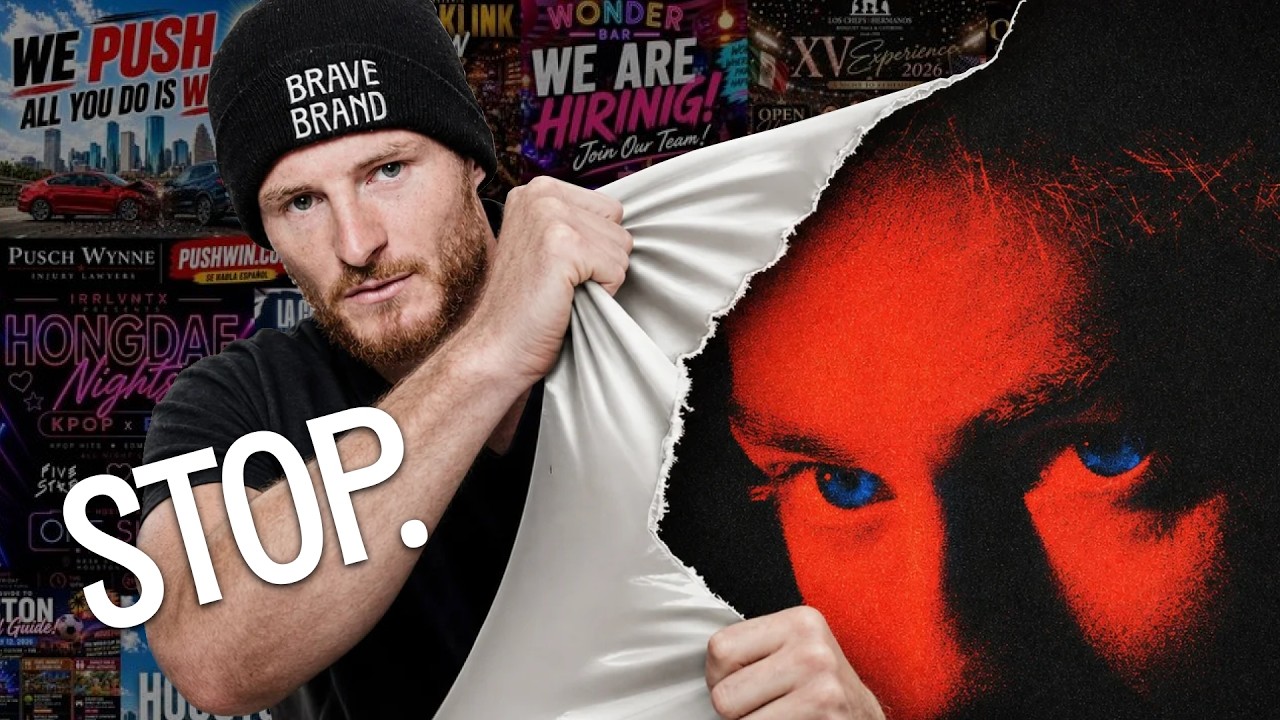
Here's something I noticed driving around Bali last week. Every crappy restaurant. Every budget estate agent. Same AI-generated images slapped on their signage, their Instagram, their Google listing. You can spot it from a moving scooter. That flat, over-lit, suspiciously perfect look that screams: nobody cared enough to think about this. And the wild thing? People are doing the exact same thing with their personal brands. Posting nine times a day, getting zero engagement, wondering why the algorithm hates them. It doesn't hate them. Their audience does — because the content looks like everyone else's content. That's the slop problem. And if you want to stop posting AI slop and build your own style instead, this article is going to show you exactly how.
Why AI Slop Is Killing Your Brand (Even If You Don't Realise It)
I broke this down on camera — the full video is below. Watch it if you want to see the live workflow in action.
The problem isn't that people are using AI. The problem is that everyone is using AI the same way — typing a vague description into ChatGPT's image generator, grabbing the first result, and posting it. When everyone uses the same tool with the same lazy inputs, everyone gets the same outputs. Your brand stops being a brand. It becomes noise. And noise doesn't build authority. It destroys it.
Here's the deeper issue: your audience has emotional antennae. They can't always articulate why a piece of content feels hollow, but they feel it instantly. Marketing that doesn't connect emotionally doesn't move people. And generic AI imagery — the kind generated by a one-liner prompt with no brand context, no taste, no curation — is the visual equivalent of a motivational quote on a sunset stock photo. It says nothing. It sells nothing. It builds nothing.
This is the core argument of the Story Over Template pillar: in a world drowning in competent content, the only thing that can't be copied is your story, your aesthetic, and your voice. AI is the instrument. Everyone has it now. What you bring is the music — the specific combination of taste, brand context, and human curation that makes your content unmistakably yours. The second you hand that over to a generic prompt, you've given up your only competitive advantage.
Why Has Prompting Alone Stopped Working?
Prompting, in its current form, is dead. That's a bold claim, but stay with me. When AI image tools first dropped, a clever prompt gave you a genuine edge. Most people didn't know how to use them, so a well-crafted description produced results that felt genuinely novel. That gap closed fast. Now every marketer, every freelancer, every corner-cutting brand manager knows the same "professional photography, golden hour lighting, cinematic depth of field" formulas. The prompts have become as generic as the outputs they produce.
More importantly, a prompt by itself carries no brand memory. It doesn't know your target audience. It doesn't know what emotional state you're trying to move them into. It doesn't know whether your brand should feel like a quiet Nordic morning or a chaotic Bali street market. Without brand context, every prompt fires blind — and blind shots produce random results, not a coherent visual identity.
This is exactly why people who "post more" with AI tools often see engagement fall rather than rise. Quantity without coherence just trains your audience to scroll past you. The feed learns you're noise. Volume accelerates irrelevance.
The Reframe: Style Is Not About Better Prompts. It's About Brand Context Plus Taste.
Here's what changes everything. Two images from the same AI, the same brand, the same day — and they look completely different in quality and feel. One looks like every other AI image you've seen. The other looks like it was shot for a premium campaign. The difference isn't a better prompt. It's a three-step process that starts with brand context and ends with human taste guiding a style lock.
This is the reframe: visual brand style is a craft decision, not a generation decision. You're not trying to write the perfect sentence and let AI spit out your brand. You're using AI as an exploration engine — a tool for surfacing thousands of aesthetic combinations — and then applying your judgment to find the one that speaks to your audience's soul. That's the opposite of slop. That's how premium brands think.
It also maps directly to why marketing keeps flopping without a brand strategy foundation. When there's no brand context underneath the execution, every tactic — including AI image generation — fires in the wrong direction. The tools aren't the problem. The absence of strategic input is.
The Three-Step Workflow to Build Anti-Slop Brand Imagery
Here's the process, broken into three clear steps. Each one matters. Skip one and you're back in slop territory.
Step 1: Feed the AI Your Brand Brain
Before a single image gets generated, the process needs brand context. This is what separates a random pretty picture from imagery that speaks to your target audience's actual psychographics — their pains, their desires, the emotional state they're in when they find you.
Inside the BraveBrand Skool community, every member builds a brandbrain.mmd file — a compiled document that holds your brand's intelligence: target audience, offers, psychographics, positioning, the emotional journey from problem to solution. It's the foundation that feeds everything, from your content strategy to your AI-native brand intelligence layer.
When you drop this file into Claude and run the Brand Scene Skill, it goes into what I call mining mode. It reads your audience data and generates specific scenes — some anchored in pain-based psychographics (the feelings your audience is trying to escape), and some in desire-based psychographics (the future they're moving toward). These aren't generic stock photo concepts. They're scenes built around the emotional world of your specific target audience. That's why they land differently.
If you don't have a brand brain yet, the skill will ask you to fill in the gaps manually. It works either way. But if you want to see what this process looks like when it's fully loaded with brand context, this breakdown of building a high-IQ AI employee shows exactly how the Brand Wiki architecture makes every AI output sharper and more on-brand.
Step 2: Mine Style References in MidJourney (Not Just Run Prompts)
Once Claude has generated your scene descriptions and MidJourney codes, the next step is exploration — and this is where most people stop doing it wrong.
MidJourney has over a billion style reference combinations baked into its model. The Brand Scene Skill generates a code using --sref random --repeat 4. What this does is run each scene prompt four times, each time pulling a completely random style reference from that billion-combination bank. In one batch, you get four visually distinct results — different color palettes, different line weights, different levels of realism — all anchored to the same scene concept.
You run this multiple times. Not to find the "right prompt." To explore aesthetic territory. You're looking for a style that makes you stop scrolling. Something that feels fresh, distinctly yours, and emotionally resonant with your audience. When you find it — and you'll know when you do — you note the style reference code that produced it. That code becomes the foundation of your brand's visual identity.
This is the craft element that turns stop posting AI slop from a slogan into a real practice. You're not outsourcing taste to an algorithm. You're using the algorithm to surface options, and then applying your judgment to curate a direction. The owner of MidJourney has been explicit about this: MidJourney is designed as a crafting tool, not a generation machine. That philosophy is built into how it works. There's no public API for a reason. The tool rewards people who show up and put in the work to discover something genuinely new.
Step 3: Lock the Style, Then Batch at Scale
Once you've found a style reference code you love, you test it. Run the same code across several different scene prompts — pain-based ones, desire-based ones, environmental ones — and check whether the style holds. Sometimes a code that looks stunning on one scene type completely clashes with another. That's normal. Delete the clashes, keep the winners.
When you've confirmed the style replicates consistently, you add your parameters: --sw (style weight, controls how hard your reference code grips the output, on a scale of 0 to 1000) and --stylize (controls how loud aesthetics get to be in general). Dialing these in together lets you fine-tune exactly how dominant your chosen style is across different prompts. A style weight of 400 with a stylize of 1000 gives you a strong stylistic grip without losing the compositional logic of each scene.
Now here's where it gets really interesting. Once the style is locked, you go back to Claude, drop in your style string, and tell the skill to go into bulk batching mode. The skill then generates a large bank of scene prompts — and it uses MidJourney's curly brace syntax to multiply each prompt into multiple variations automatically. One prompt line with three options inside curly braces generates three separate images in a single submission. Run ten prompt lines like that and you're producing thirty images in the time it used to take to run one.
The session described in the video produced 310 images from a single batching session, then after a day of working: 140 download-ready assets, all sitting inside a coherent brand style, all anchored to scenes your specific target audience actually responds to. That's your content bank. That's the raw material for your social media, your carousels, your ads, your website, your emails — all looking like they belong to the same brand world.
AI is the instrument everyone has. Your style is the music only you can write. The second you skip the curation step, you hand your competitive edge back to the algorithm.
What Happens After You Have the Bank
The bank isn't the end product. It's infrastructure. Once you've got 100 to 200 on-brand images locked in, you can feed them into automation workflows that produce social media carousels, posts, and ads without starting from scratch each time. The next layer — which we'll cover in a follow-up — is how to take that image bank and build a carousel automation that pulls from it automatically, combining your brand imagery with your content to produce unique designed posts every week at scale.
This is what the long sword strategy looks like in practice. The Brand Scene Skill session is a few hours of front-loaded craft work. The output powers months of content. That's the compound effect the authority measurement framework is built around — effort that accumulates rather than effort that evaporates the moment you stop posting.
And here's the thing that matters most: when your visual style is distinct, your audience starts to recognise your content before they read a word of it. That's brand equity. That's the difference between someone who scrolls past and someone who stops, reads, and eventually buys. Generic AI imagery trains people to ignore you. A locked, curated, emotionally resonant visual style trains them to pay attention.
This Is Story Over Template in Action
The Story Over Template pillar exists because of a simple truth: templates are available to everyone. The moment a format, a framework, or a visual style becomes a template, it stops being differentiated. It becomes the baseline. And baseline doesn't build authority — it just keeps you in the game.
Your story — your specific aesthetic choices, your brand's emotional world, the particular way you've decided to represent your audience's pain and desire visually — that can't be templated. It can't be copied by a competitor who just types into ChatGPT. It requires the same thing every genuinely valuable brand requires: human taste, brand context, and the willingness to put in the exploratory work that most people skip because it feels slow.
The workflow in this article isn't slow. It's front-loaded. You spend a few hours mining, testing, and locking a style once. Then that style does the heavy lifting for the next six months. That's not a content treadmill. That's a system.
If anyone in your niche could have made your post, don't post it. That's the one-line test for every piece of content that leaves your brand. Apply it to your imagery as ruthlessly as you apply it to your writing. The result is content that actually stops the scroll — not because it's louder, but because it's genuinely different.
Ready to Build a Visual Brand That Doesn't Look Like Everyone Else's?
The Brand Scene Skill, the brand brain workflow, and the full content system are all inside the BraveBrand community. That's where we teach this — live, step by step, with the actual tools and files you need to run it yourself. If you want to stop posting AI slop and build your own style instead, this is the place to start.
Join the BraveBrand community on Skool — it's free to start, and Lesson 5 alone will give you the brand brain file that powers everything in this article.
Or if you'd rather see how this plays out with a full brand build — done for you, from Brand Wiki to Digital Home to content system — work with BraveBrand directly and we'll build the whole thing together.
Want to watch the full workflow live? Watch the video version on YouTube — it's the fastest way to see every step in real time.
Frequently Asked Questions
What exactly is AI slop and why does it hurt my brand?
AI slop is imagery (and content) generated by AI tools with no brand context, no curation, and no human taste applied to the output. It looks like everything else in the feed because it came from the same generic prompts everyone else uses. When your audience sees it, they feel the hollowness — even if they can't name it — and they scroll past. Over time, stop posting AI slop and build your own style instead becomes less of a creative preference and more of a business necessity, because undifferentiated visual content is actively training your audience to ignore you.
Do I need technical skills to run this workflow?
No. The Brand Scene Skill runs inside Claude — you drop in your brand brain file, type a command, and it does the analysis. MidJourney is a web-based tool with a simple prompt interface. The most important skill in this entire process is taste: the willingness to look at generated outputs and make a judgment call about what feels right for your brand.
What is a style reference code in MidJourney and why does it matter?
A style reference code is a unique identifier that points to a specific aesthetic combination inside MidJourney's model — colours, line weights, mood, rendering style. When you find a code that produces imagery that feels genuinely on-brand, locking that code into all your future prompts means every image you generate from that point forward shares the same visual DNA. That's how you stop posting AI slop and build your own style instead of recreating it from scratch every time.
How many images can I realistically produce in one session?
Using the curly brace batching technique described in this article — where a single prompt line generates multiple variations automatically — a full skill-driven session can produce over 300 images. After curation and deletion of anything that doesn't fit the style, you're typically left with 100–150 high-quality, on-brand assets ready to use across social media, carousels, websites, and ads.
What is the brand brain file and where do I get one?
The brand brain is a structured document — saved as a .mmd file — that holds your brand's intelligence: target audience, psychographics, offers, positioning, and the emotional journey your audience is on. Inside the BraveBrand Skool community, Lesson 5 walks you through building yours from scratch. Without it, every AI tool you use is firing blind; with it, every output is calibrated to your specific audience's pains and desires.
Can I use this workflow for written content as well as images?
Yes. The brand brain architecture that powers the Brand Scene Skill for imagery is the same foundation that powers AI writing in your voice, content strategy, and the broader Digital Home system. The principle is identical: when you feed an AI tool rich, specific brand context rather than generic prompts, the outputs stop being slop and start being strategy. For more on the written side of this, the AI-native brand intelligence article covers how the Brand Wiki makes every content output sharper.

Luke Carter
Luke Carter is the founder of BraveBrand and is an authority on branding and neuromarketing that drives business growth. Say 👋 on LinkedIn!
Want To Build This Yourself?
The Digital Village is where founders build their own brand and AI systems next to other people doing the same. It runs on Skool for $14 a month.
Join The Village