
The Unseen Engine: Why Anchor Rituals Define Success in Sales and on Stage
Key Takeaways
Stop leaving your performance to chance; deliberately manufacture focus on demand with a pre-performance Anchor Ritual.
Design your ritual with a clear trigger and a brutally simple, repeatable routine that can be performed anywhere.
Execute your ritual with non-negotiable consistency to build a powerful, automatic association between the routine and your peak performance state.
Replace your accidental, anxiety-driven habits with an intentional process that puts you in control of your mental state.
There’s a moment of sheer, cold panic every professional knows. It’s the three seconds of dead air after you’ve asked a prospect for a six-figure deal, and the silence on the other end of the line feels like a judgment. It’s the split-second before you walk on stage when your mind, a traitorous blank slate, suddenly forgets the killer opening line you practiced for weeks. In these moments, your finely tuned strategy, your brilliant slides, and your expensive suit are all worthless. Your performance has been hijacked by your own biology. Most people treat this as a game of chance, a roll of the psychological dice. They hope for a good day, brace for a bad one, and call the whole chaotic mess a career. This is, to put it mildly, an idiotic way to manage a high-stakes profession.
The truth is, the world’s most consistent performers - from surgeons to snipers to top-tier salespeople - leave nothing to chance, especially not their own mental state. They don't just hope they'll be focused; they run a deliberate, repeatable process that manufactures focus on demand.
This process is the Anchor Ritual, a short sequence of actions performed immediately before a critical event to consciously shift your mind and body into a peak performance state. It’s not a superstitious lucky charm or a vague intention to "be confident." It is a meticulously designed tool hired for a specific job: to fire anxiety and distraction and hire clarity and presence. Understanding how to build and deploy your own Anchor Ritual is the fundamental difference between being a passenger in your own career and getting into the driver's seat.
What Exactly Is an Anchor Ritual?
At its core, an Anchor Ritual is a pre-planned, non-negotiable routine that serves as a psychological trigger. Think of a concert violinist before a performance. She doesn’t just grab her Stradivarius and hope for the best. She follows a precise ritual: she tunes each string, rosins her bow, and adjusts her posture. These actions don't magically make her a better violinist, but they ensure her instrument is perfectly prepared and her mind is transitioned from the backstage chaos to the singular focus of the music.
Your mind is your instrument, and without a similar tuning process, you’re walking into every major sales call and keynote playing out of key. An Anchor Ritual isn't about the actions themselves; it's about the consistent, predictable mental state they produce.
A well-designed Anchor Ritual is strikingly simple and consists of a clear trigger and a short, repeatable routine. The trigger is the cue that the performance is imminent - for instance, the calendar notification for a sales call popping up ten minutes beforehand. The routine is the series of steps you take in response. This isn't the time for a 45-minute meditation or a complex series of affirmations that sound like they were written by a greeting card company. A powerful ritual might be as brief as closing every browser tab, standing up to stretch, reading a single index card with the client's most critical pain point, and taking three deep, diaphragmatic breaths.
The goal is not to add more tasks but to systematically shed distractions and activate the right mental framework. It’s the brain’s equivalent of a pilot running through a pre-flight checklist - a deliberate process that replaces the variable of human emotion with the reliability of a system.
How Do Anchor Rituals Actually Work on the Brain?
The human brain is a marvel of processing power, but it’s also laughably inefficient when overloaded. Every moment you spend worrying - Did I prepare enough? What if they ask about our competitor? Is my fly down? - consumes precious mental bandwidth. This is known as Cognitive Load. A brain struggling under a high Cognitive Load is slow, reactive, and prone to error. It’s the frantic mental state of an amateur.
An Anchor Ritual works by systematically offloading the job of "getting ready" to a subconscious habit, freeing up your conscious mind to focus entirely on the task at hand: listening to the client, reading the audience, and connecting with the person in front of you.
This process creates what neuroscientists call a conditioned response. Just as Pavlov's dogs learned to associate the sound of a bell with food, your brain learns to associate your specific ritual with a state of calm, focused performance. Each time you execute your ritual before a successful call or presentation, you strengthen that neural pathway. Eventually, the ritual itself becomes the key that unlocks your desired Performance State.
It’s no longer an effortful process; it’s an automatic transition. This is why a ritual based on superstition, like wearing lucky socks, is a flimsy crutch. It relies on belief. A ritual based on psychology, like controlled breathing to regulate your nervous system, is a reliable tool. It relies on biology. You’re not hoping for magic; you’re flipping a physiological switch you installed yourself.
The Anatomy of a Powerful Anchor Ritual for Sales Calls
Sales calls are a uniquely challenging arena. They demand a delicate balance of deep listening, strategic questioning, and confident authority, all while navigating the unpredictable currents of another person’s personality and agenda. Entering this environment mentally scattered is a recipe for disaster. The job of a sales-specific Anchor Ritual is to transition you from the administrative chaos of your day into the focused, empathetic mindset of a trusted advisor. It’s about creating a bubble of psychological safety and clarity just before you dial.
Let's look at the case of a successful account executive. Her old "ritual" was probably a familiar one: frantically re-reading her notes, checking Slack one last time, and taking a nervous gulp of lukewarm coffee, all while a dozen browser tabs screamed for her attention. This isn't a ritual; it's a self-inflicted stress test. Her new, intentional Anchor Ritual begins ten minutes before the call. The calendar alert is her trigger.
First, she closes every single application on her computer except for her notes and the video conference window. This single act eliminates the potential for distraction and signals to her brain that nothing else matters for the next hour.
Next, she stands up, does a simple 30-second stretch to release physical tension, and drinks a glass of water. This changes her physiological state.
Finally, in the last two minutes, she reads a single page - not a dense dossier, but one clean sheet summarizing the client’s primary problem in their own words, and the one critical question she must get an answer to. This focuses her intent.
The last step, just before clicking "Join," is to take three slow, deliberate breaths and silently recite her personal mantra: "I am here to solve a problem." This entire sequence takes less than five minutes, yet it completely transforms her mental starting point from reactive anxiety to proactive calm.
Designing an Anchor Ritual for the Keynote Stage
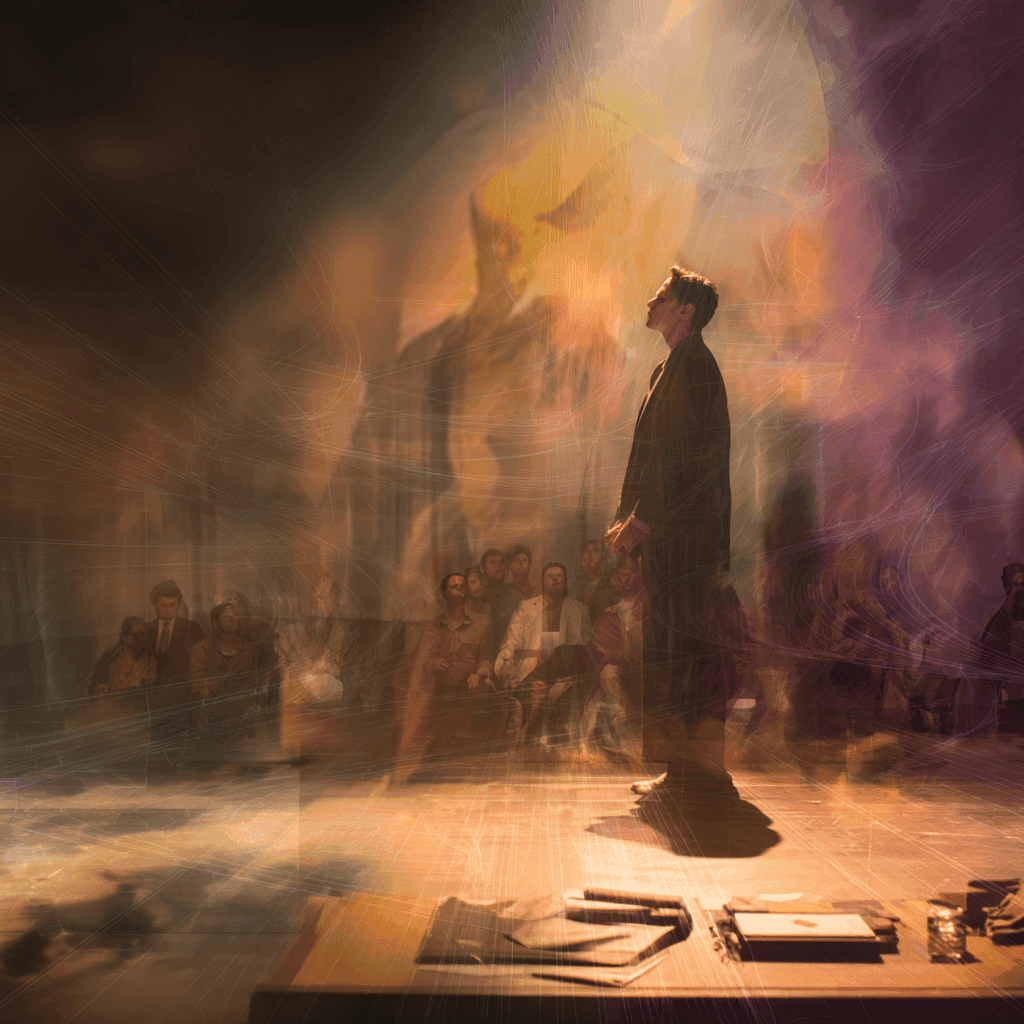
While a sales call is an intimate duel, a keynote is a broadcast. The challenge isn't navigating a conversation; it's commanding a room and projecting energy, confidence, and authority to dozens or hundreds of people simultaneously. Stage fright is the enemy here - the primal fear of public judgment that can hijack your breathing, muddle your thoughts, and turn a powerful message into a forgettable lecture. The Anchor Ritual for a keynote, therefore, must be designed specifically to combat this physiological assault and cultivate an expansive sense of presence.
Consider a founder about to give a critical pitch to a room full of investors. The amateur tinkers with their slides until the last possible second, a clear sign of insecurity. The professional trusts their preparation and focuses entirely on their state. Thirty minutes before showtime, she finds a quiet space - even a bathroom stall will do. Her phone goes into airplane mode. No more emails, no more "quick checks" on the news.
For the next fifteen minutes, she might listen to a specific, high-energy playlist, a technique that leverages state-dependent memory to associate certain songs with feelings of confidence. With five minutes to go, she engages her body. She might do a "power pose" - standing tall, with her hands on her hips, a simple physiological hack proven to increase feelings of confidence and decrease the stress hormone cortisol.
In the final minute before being introduced, she visualizes her first 30 seconds on stage going perfectly. She sees herself walking out, smiling, and delivering her opening line with warmth and power. This isn't wishful thinking; it's a mental rehearsal that primes the brain for success. When her name is called, she isn’t walking out hoping it goes well; she’s executing a plan that began 30 minutes earlier.
What Makes Most Pre-Performance Routines Fail?
Many people claim to have a routine, but upon inspection, it’s little more than a collection of nervous tics and flimsy superstitions. These "rituals" fail because they lack the core principles that make an anchor effective. The primary cause of failure is a lack of intention and consistency.
A true Anchor Ritual is non-negotiable. It’s performed with the same diligence before a small, internal meeting as it is before a career-defining pitch. Doing it "sometimes" is like trying to build muscle by going to the gym once a month; the necessary adaptation never occurs. The brain requires disciplined repetition to build the strong, automatic association between the ritual and the desired Performance State.
Another critical failure point is over-complexity. A 12-step ritual involving scented candles, specific incantations, and a series of convoluted physical movements is not a tool; it's a burden. It creates more anxiety than it relieves because there are more points of potential failure. The most robust rituals are brutally simple, portable, and can be executed anywhere, from a noisy green room to a cramped office cubicle.
Finally, routines fail when they are untethered from a clear psychological or physiological purpose. Carrying a lucky rabbit's foot doesn't actively change your neurochemistry.
In contrast, taking slow, deep breaths directly stimulates the vagus nerve, signaling to your parasympathetic nervous system that it’s time to calm down. One is a hope; the other is a command. People cling to complexity and superstition because it feels like they’re doing something, but they’re just spinning their wheels. True preparation is about doing less, but doing the right things with unwavering consistency.
From Accidental to Intentional Performance
The gap between mediocre performers and elite professionals has very little to do with talent and everything to do with process. The most decorated athletes, accomplished surgeons, and compelling speakers don’t just show up and let the chips fall where they may. They understand that peak performance is not an accident; it is an engineered outcome. They build systems to manage their energy, their focus, and their nerves, allowing their talent to shine through unencumbered by mental friction. The Anchor Ritual is the cornerstone of that system - a small, deceptively simple lever that produces an outsized impact on results.
Ultimately, you must grapple with a fundamental question. You already have a pre-performance ritual, whether you realize it or not. For many, that ritual consists of mindless scrolling on social media, catastrophizing about what could go wrong, and mainlining caffeine until their hands shake. This is the ritual that anxiety has designed for you. The only choice you have is whether to continue letting chaos and chance dictate your mental state, or to consciously design a new ritual - one built on purpose, discipline, and an understanding of your own psychology.
Stop white-knuckling your way through the most important moments of your career. Build the machine that puts you in control.
Frequently Asked Questions
1. What is an Anchor Ritual and what is its primary purpose?
An Anchor Ritual is a deliberate, repeatable sequence of actions performed immediately before a critical event, such as a sales call or a presentation. Its primary purpose is to consciously shift your mind and body into a peak performance state by systematically replacing anxiety and distraction with clarity and presence. It is a meticulously designed tool for manufacturing focus on demand.
2. How does an Anchor Ritual work on the brain to improve performance?
An Anchor Ritual works by reducing "Cognitive Load" - the mental bandwidth consumed by worry and distraction. By offloading the task of "getting ready" to a subconscious habit, it frees up your conscious mind to focus on the performance itself. This process creates a conditioned response, where your brain learns to associate the specific ritual with a state of calm, focused performance, making the transition to your desired "Performance State" automatic and reliable.
3. What are the key components of an effective Anchor Ritual?
A well-designed Anchor Ritual is strikingly simple and consists of two key components:
A clear trigger: This is the cue that the performance is imminent, such as a calendar notification for a sales call popping up ten minutes beforehand.
A short, repeatable routine: This is a brief series of steps taken in response to the trigger. A powerful routine might include closing browser tabs, stretching, reviewing one key point, and taking three deep, diaphragmatic breaths.
4. Why do many pre-performance routines and rituals fail?
Most pre-performance routines fail for three main reasons:
Lack of intention and consistency: A true Anchor Ritual must be non-negotiable and performed with disciplined repetition to build the necessary neural pathway.
Over-complexity: A ritual with too many steps creates more anxiety than it relieves and is not portable. Robust rituals are brutally simple.
No clear purpose: Routines based on superstition (like lucky socks) are a flimsy crutch because they are not tethered to a clear psychological or physiological purpose. An effective ritual uses biology, such as controlled breathing, to reliably regulate the nervous system.
5. What is an example of a powerful Anchor Ritual for a high-stakes sales call?
A powerful sales-specific Anchor Ritual can begin ten minutes before a call. The trigger is the calendar alert. The routine could be:
Close every application on the computer except for the notes and video conference window to eliminate distractions.
Stand up, do a 30-second stretch, and drink a glass of water to change your physiological state.
Read one single page summarizing the client’s main problem and the one critical question you need answered.
Just before joining, take three slow, deliberate breaths and silently recite a mantra like, "I am here to solve a problem."
6. How can a public speaker design an Anchor Ritual for a keynote presentation?
To combat stage fright and command a room, a speaker's Anchor Ritual should focus on cultivating presence and confidence. For example, thirty minutes before the presentation, the speaker could:
Find a quiet space and put their phone on airplane mode.
Listen to a specific, high-energy playlist to trigger a confident state.
With five minutes left, perform a "power pose" (e.g., standing tall with hands on hips) to physiologically boost confidence and lower cortisol.
In the final minute, visualize the first 30 seconds of the speech going perfectly, priming the brain for success.

Luke Carter
Luke Carter is the founder of BraveBrand and is an authority on branding and neuromarketing that drives business growth. Say 👋 on LinkedIn!
Ready To Scale Your Brand?
Put an end to DIY branding an ineffective marketing and start attracting premium clients with total clarity.
Let's Chat Strategy