
Most people who try to use AI for client content end up with something that looks fine and feels like nothing. It scans okay. It has the right words in the right order. But it does not sound like the person whose name is on it, and every experienced practitioner in the room knows it the second they read it. That is the real problem with the AI-powered carousel workflow most freelancers are running right now — not the tool, not the template, not the turnaround time. The story is missing, and no prompt fixes that.
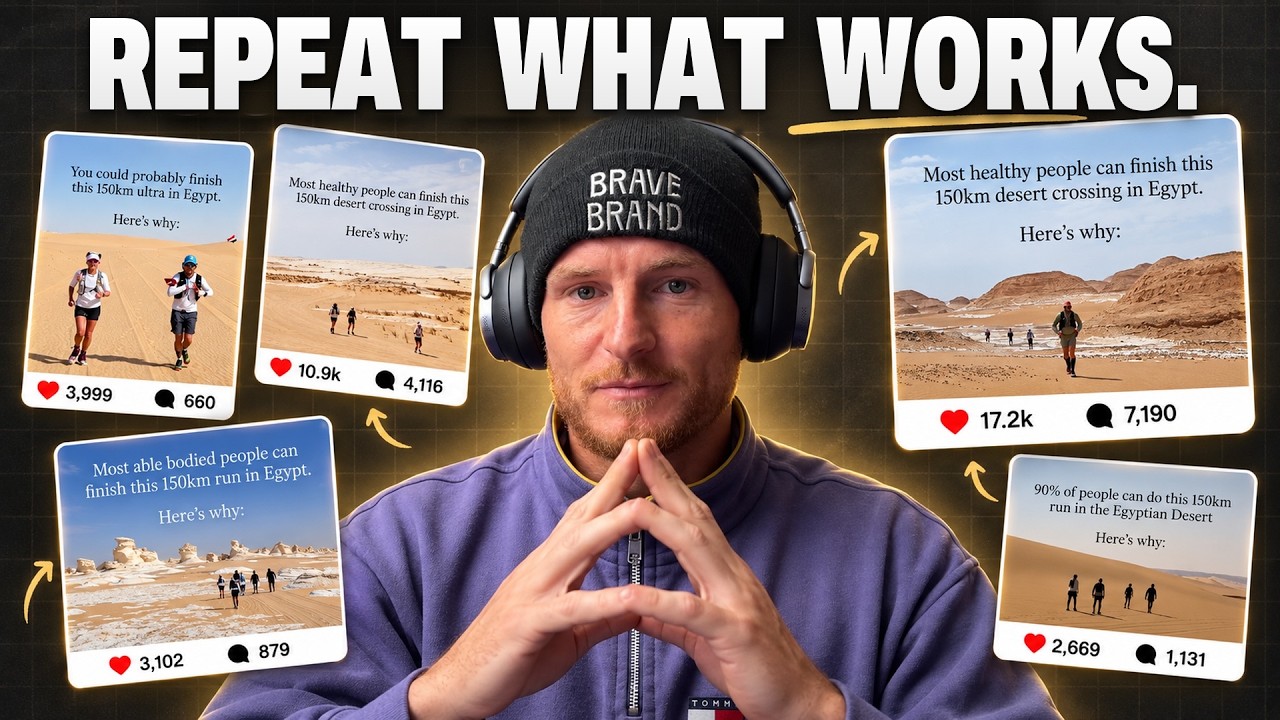
I broke this down on camera with a real client build — Giles — and the full giles story cut v2 fuller ai-powered carousel workflow demo is below. Watch it first if you want to see the screen, then come back and read this if you want the argument behind it.
Watch the Full AI-Powered Carousel Workflow Demo
Why Does Every AI Carousel Feel the Same?
Because everyone is starting from the same place. They open the AI, paste in a topic, ask for ten carousel slides, and get ten carousel slides. The output is competent. It is also completely anonymous. You could swap the brand name on slide one and nothing else would change — the tone, the structure, the examples, the energy. It fits anyone because it belongs to no one.
This is the thing the market keeps getting wrong about AI content. The problem was never speed. Experienced designers and developers were already fast. The problem is that speed without a story just produces more of the same thing faster. And more anonymous content does not help a client stand out — it accelerates the noise they are already drowning in.
Giles is a good example of why this matters. He is an established professional with a real point of view, real experience, and a specific kind of client he serves well. None of that showed up in the first pass of carousel content he brought to me. What showed up was a set of slides that could have been written for anyone in his category. Competent. Invisible. The worst possible combination when you are trying to charge premium rates for content work.
The AI did not fail him. The workflow did. Specifically, the workflow skipped the one step that makes AI content actually useful: extracting the story before you touch the tool.
What Most Freelancers Try First (And Why It Keeps Disappointing Them)
The standard freelancer response to bad AI output is to edit harder. They take the generic carousel, rewrite the hook, swap a few words, add the client's name in a few places, and call it done. It is faster than writing from scratch, so it feels like progress. It is not progress. It is polishing something that was built wrong from the start.
The second common attempt is better prompting. More detail in the brief, more examples in the prompt, a longer system message. This helps — marginally. The output gets closer to the client's voice, but it still lacks the specific texture that makes content recognizable. It still sounds like a polished version of a general template rather than something this particular person would actually say.
The third attempt, and the one I see most often from technically capable practitioners, is switching tools. A different AI model, a different content platform, a different carousel builder. The tool is not the variable that matters. You can run the giles story cut v2 fuller ai-powered carousel workflow demo in any AI environment and get the same result if the input is generic, because the tool amplifies what you give it.
None of these attempts address the real bottleneck. The real bottleneck is that the practitioner does not have a structured way to pull the client's actual story out before the AI ever touches it. Without that, the AI is writing fiction — technically accurate, emotionally absent fiction.
The Reframe: AI Is the Instrument. Giles's Story Is the Music.
This is the argument BraveBrand makes again and again, and it is the one that finally lands when people see it applied to a real build rather than explained in the abstract. AI is an instrument. Every freelancer, every agency, every solopreneur has access to the same instrument right now. The instrument does not differentiate you. The music does.
The music — the specific story, the lived experience, the particular way Giles describes a problem his clients face, the metaphor he uses without thinking about it, the moment he had three years ago that changed how he works — that is the thing AI cannot generate on its own, because it does not exist anywhere in the training data. It exists only in Giles's head, and the only way it ends up in the carousel is if someone knows how to pull it out first.
This is the Story Over Template pillar in practice. Not as a slogan. As a literal workflow step that changes the quality of the output at the source. You do not get a better carousel by editing the carousel. You get a better carousel by doing better extraction before the carousel exists.
Once you understand this, the AI-powered carousel workflow stops being a content production tool and starts being a story delivery mechanism. The AI handles the formatting, the structure, the slide logic, the hook variations, the call to action. You handle the irreplaceable part: the specific, true, human detail that makes the content impossible to copy and impossible to ignore.
The Actual Workflow: How the Giles Story Cut Works Step by Step
The giles story cut v2 fuller ai-powered carousel workflow demo is built around four phases. They are not complicated. They are just disciplined, and that discipline is what separates the content that gets saved and shared from the content that gets scrolled past.
Phase one: Story extraction before anything else. This is a structured conversation — not a brief, not a questionnaire — designed to surface specific moments, specific language, and specific beliefs Giles holds that his clients do not. The questions are not about what he does. They are about why he started, what surprised him, what he sees that his clients cannot see yet, and what he has said in a real conversation that made someone lean forward. The output of this phase is raw material: unedited, unformatted, completely his.
Phase two: Story sorting. Not everything that comes out of the extraction is carousel material. Some of it belongs in a long-form article. Some belongs in a sales conversation. Some belongs in a case study. The sorting step identifies which moments have the right structure for carousel content — a clear before, a clear shift, a clear after — and pulls those to the front. This step also identifies the language patterns: the specific words and phrases Giles uses that should appear in the carousel verbatim, because they are part of his voice.
Phase three: AI-assisted structure and expansion. Now the AI comes in. The input is not a topic. It is a story moment, a set of exact phrases, a defined audience, a slide count, and a specific emotional destination. The AI's job is to wrap that input in a carousel structure that makes it easy to consume. It suggests hook variations, proposes the slide sequence, writes the body copy in a register informed by the raw material, and drafts a call to action that follows from the story rather than being bolted on at the end. The output sounds like Giles because the source material was Giles.
Phase four: Voice review, not copy edit. The final pass is not about fixing grammar. It is about asking one question: does this sound like him? If a line is technically correct but uses vocabulary Giles would never use, it gets rewritten. If a slide is logically sound but emotionally flat compared to the extracted material, it gets replaced with a direct pull from the raw story. The carousel does not get approved until every slide passes that single test.
The whole process is faster than it sounds when you have done it a few times. The extraction typically runs forty-five minutes to an hour for a new client. After that, each carousel takes a fraction of the time it used to, and the output is consistently strong enough to charge premium rates for — not because it is AI-assisted, but because it is genuinely differentiated content that the client cannot easily replicate with a $20 subscription on their own.
What This Does to Your Rates (and Your Reputation)
Here is the practical consequence of running this workflow instead of the default one. When you hand a client a carousel built this way, they do not recognize it as AI output. They recognize it as themselves — articulated better than they could have done it alone. That reaction is worth far more than a completed deliverable. It is the moment the relationship shifts from vendor to trusted practitioner, and trusted practitioners do not compete on price.
The freelancers who are getting compressed right now — who are being asked to polish AI slop for rates that do not reflect their skill — are in that position because the work they are producing is indistinguishable from what the client could get from a cheaper tool or a lower-rate provider. That is not a market problem. It is a workflow problem. The market is absolutely still paying premium rates for content that is specific, credible, and impossible to replicate. The question is whether your process produces that kind of content.
Anna Simonsson-Søndena is a good example of what happens when the story is the foundation. She went from roughly €300 a month living in a van to €8,000 revenue days — not because she got faster at producing content, but because the content she was producing finally reflected who she actually was and what she actually believed. The specificity is what converted. You can see results like hers and others on the case studies page.
The same logic applies to Giles. The carousel workflow is not a production shortcut. It is a positioning tool. Every piece of content that goes out with his name on it either reinforces or dilutes the premium perception he is trying to build. Generic content dilutes it regardless of how quickly it was produced. Story-led content reinforces it regardless of whether AI helped write it.
If you are building client work in this space, this is also directly relevant to how you sell the service. The conversation stops being about deliverables — number of carousels, turnaround time, revision rounds — and starts being about the extraction and strategy layer that makes the deliverables worth having. That layer is where your rate lives. And that is the one part of the workflow that AI genuinely cannot replace. For a deeper look at how to turn this kind of content work into a repeatable client acquisition engine, this article on content marketing as a client acquisition system is worth reading alongside this one.
Why Story Over Template Is Not Just a Content Philosophy
The Story Over Template pillar is not about being anti-AI. BraveBrand runs AI agents across its entire operation — content, outreach, follow-up, ops. This is not a craft-versus-technology argument. It is a differentiation argument, and the differentiation case for story-first content is getting stronger, not weaker, as AI tools become more widely available.
When everyone has the same tool, the tool stops being the advantage. This is happening in real time in the content space. Two years ago, using AI for content production was a competitive edge because most practitioners were not doing it. Now most practitioners are doing it, and the output is converging toward a mean that is technically competent and emotionally flat. The practitioners who are pulling away from that mean are the ones who figured out that the AI is most powerful when it is working with genuinely specific source material — and that producing genuinely specific source material requires a process the AI cannot run on its own.
This is also why the giles story cut v2 fuller ai-powered carousel workflow demo is worth paying attention to even if you never do carousel content. The principle generalises. Whether you are producing blog posts, email sequences, sales pages, video scripts, or LinkedIn content, the same dynamic applies. Generic input produces generic output. Extracted, specific, story-first input produces content that sounds like a real person with a real point of view — and that is the content that builds an audience, earns trust, and converts at premium rates.
For a deeper look at why your story is the one thing AI genuinely cannot replicate — and how to make that your structural advantage — this piece on what AI can and cannot copy lays it out in full.
Ready to Build Content That Actually Sounds Like Your Client?
If this resonated, the next step is straightforward. The BraveBrand community on Skool is where we teach the full Digital Home workflow — including how to run story extraction, how to structure AI-assisted content production, and how to build a content system that produces differentiated output consistently. It is free to start, and the people inside it are practitioners at the same level you are, not beginners looking for a place to start from scratch.
If you want to see the full workflow on screen before you do anything else, the video is here: Watch the Giles Story Cut AI-Powered Carousel Workflow Demo on YouTube.
Join the BraveBrand community on Skool and bring your next client project with you. We'll show you how to run the extraction before the AI ever opens.
Frequently Asked Questions
What is the Giles Story Cut AI-powered carousel workflow demo actually showing?
The giles story cut v2 fuller ai-powered carousel workflow demo walks through a four-phase content process: story extraction from the client, sorting that material for carousel suitability, using AI to structure and expand the story into slides, and a voice review pass to make sure it sounds like the actual person. The demo uses a real client — Giles — so you see the workflow applied to genuine source material rather than a hypothetical example.
Do I need a specific AI tool to run this carousel workflow?
No. The tool is not the variable that matters. The giles story cut v2 fuller ai-powered carousel workflow demo is built around the principle that specific, extracted story material produces strong output regardless of which AI you use. Claude, ChatGPT, Gemini — any capable model will produce better carousel content when the input is specific than a cheaper or older model given a generic topic prompt.
How long does the story extraction phase take for a new client?
For a new client, the structured extraction conversation typically runs forty-five minutes to an hour. After that first session, subsequent projects are significantly faster because you already have the core voice material and can build on it. The time investment in extraction pays back across every piece of content you produce for that client from that point forward.
Can I charge more for AI-assisted content if clients know AI is involved?
Yes — if the output is genuinely differentiated and the client can hear themselves in it. The rate compression happens when AI-assisted content is indistinguishable from generic AI output, because that is a commodity. Content built on extracted story material that passes a voice review commands premium rates because the client cannot easily replicate it themselves, and they know it the moment they read it.
What makes this different from just writing a better prompt?
Better prompting improves the AI's output within the constraints of what it already knows. Story extraction gives it entirely new source material — specific moments, specific language, specific beliefs — that do not exist in any training data and cannot be inferred from a topic brief. The difference in output quality is not marginal. It is the difference between content that sounds like a category and content that sounds like a specific person.
Is this workflow only useful for carousel content?
The extraction and story-first principle applies to any content format: email sequences, blog posts, sales pages, video scripts, LinkedIn posts. Carousel is a good demonstration format because the slide structure makes it easy to see where generic content fails — each slide either earns attention or loses it — but the underlying workflow improves output quality across every format you might produce for a client.

Luke Carter
Luke Carter is the founder of BraveBrand and is an authority on branding and neuromarketing that drives business growth. Say 👋 on LinkedIn!
Ready To Scale Your Brand?
Put an end to DIY branding and ineffective marketing, and start attracting premium clients with total clarity.
Let's Chat Strategy