
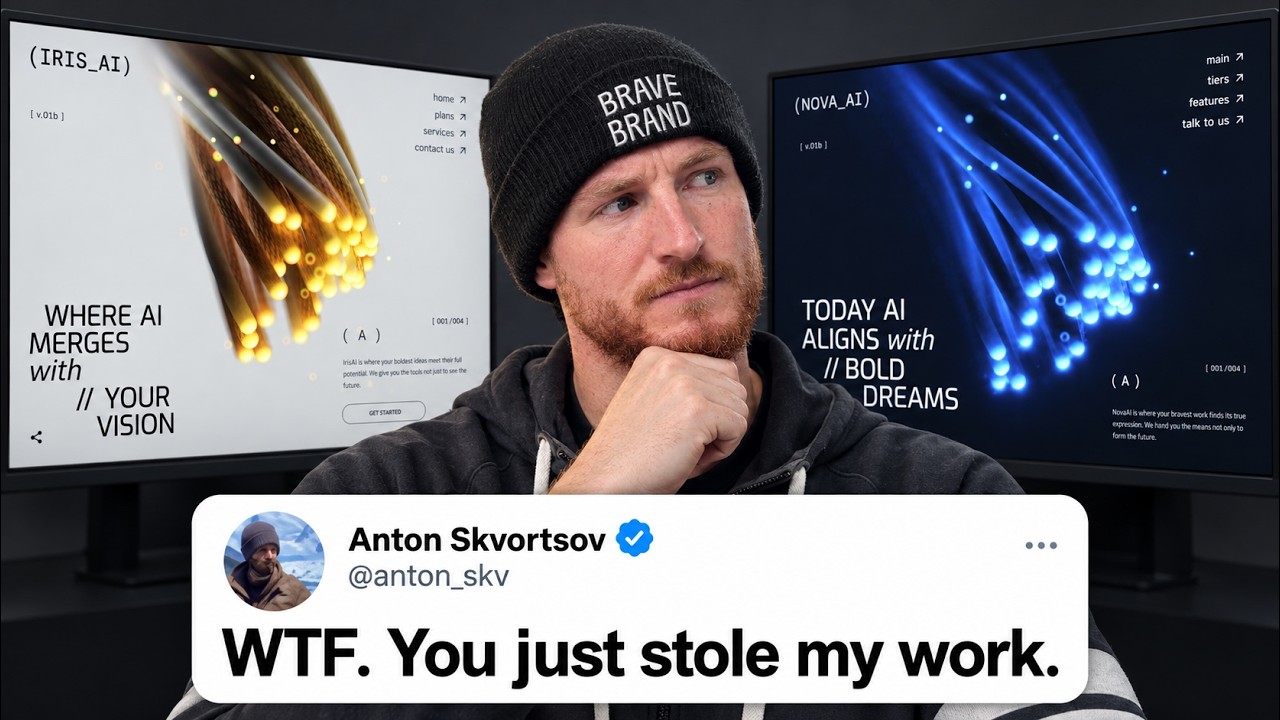
Someone cloned a designer's entire website last week. Same layout. Same background animation. Same hero section. Word-for-word copy. The original creator posted it on X, furious — and the comments lit up like a bonfire. Then another designer shared her story. Her work, her words, her personal site: duplicated with a few color changes and a tweaked headline. "More than a link in bio, your personal website" became "More than a link in your bio, a personal website." The theft was brazen. The outrage was real. And here's the uncomfortable part — if you're building anything online right now, this is coming for you too.
I broke this down on camera — the full video is below. But whether you watch it or not, what I want to give you here is the argument underneath the outrage. Because the designers screaming on X are right to be angry, but they're fighting the wrong war.
Why AI Can Copy Your Website (And Always Will)
This isn't a shady trick anymore. It's a feature. Hostinger now has a button that literally says "clone any website, change it with AI." Framer recommends you screenshot a competitor's site and build something similar. You can paste a URL and get an editable copy in under ten seconds. Mainstream website builders are advertising this capability openly, to paying customers, right now.
So the panic is understandable. Developers, designers, and creatives who built their moat around skill and execution — around being the person who could produce the thing nobody else could — are watching that moat fill in. And they're asking the right question: if anyone can copy your work by clicking three buttons, where does the value actually go?
Here's where I want to push back on the framing, because I think most people are solving the wrong problem. The issue isn't that AI can copy your website. The issue is that your website was your moat in the first place. And that's a 250-year-old idea that was never quite as true as we believed it to be.
Where Did Originality Come From Anyway?
Quick test. Who designed the three-tier pricing table? Who invented the hamburger menu? Who first put a big headline with two buttons underneath it in every hero section you've ever seen? Nobody owns those. They're everywhere. They've always been everywhere. And that's not an AI problem — that's just how creative culture has always worked.
For most of history, making things was a group effort. Painters ran workshops where apprentices did the actual painting and the master's name went on the canvas. Buildings across London and Paris share the same classical patterns not because one architect copied another, but because the style was shared culture. Walk through the Sistine Chapel — the subjects differ, but the Renaissance style runs through everything, painted by different hands across decades.
In 1710, Britain passed its first copyright law. It came out of the printing press era, when books started to move at scale and someone had to figure out who got paid. So we invented a character: the author. The genius who creates from nothing, pulling finished work out of thin air. It was a useful fiction. It decided who got attributed, who got the money, who got the credit. And it stuck for 300 years.
In 1967, a French thinker named Roland Barthes published an essay called "The Death of the Author." His argument was straightforward: nobody creates in a vacuum. Every piece of writing is stitched together from everything the writer has ever read, heard, and seen. Barthes suggested dropping the word "author" entirely and using a different word: scriptor. A scriptor doesn't invent from scratch. They mix and rearrange what already exists. That's not a provocation — that's a description of how creativity actually works.
In 2026, AI has made Barthes's scriptor a technical reality. A large language model uses its training data and remixes it into something that looks new. That's exactly how it works. And it's also — if you're honest about it — exactly how your brain works too.
So If Everything Is a Remix, What Can't Be Copied?
Here's the thing about remix machines with no one steering them: they don't give you something new. They give you the most average, most obvious answer. In 2024, Figma launched an AI tool that could design apps from a text prompt. A designer asked for a weather app and it kept generating something that looked almost exactly like Apple's default weather app. Figma had to shut the feature off. The machine was remixing without a point of view — so it converged on the mean.
Remixing is free. Steering is scarce.
Hold that thought. Now rewind to 2016. Instagram released Stories — a pixel-for-pixel copy of Snapchat Stories. They didn't even change the name. The internet lost its mind. The Instagram CEO at the time didn't deny it. He openly gave Snapchat the credit and said this wasn't about invention, it was about a format — and what mattered was putting your own spin on it. Within two months, 100 million people were using Instagram Stories.
Formats are shared culture. Ideas spread and remix. That's always been true. But what Instagram brought was taste, speed, execution, and a community that already trusted the product. Nobody could copy that. Not because it was protected. Because it was earned.
There's a line, and it's worth being clear about it. Formats, layouts, and patterns are shared culture. Nobody owns the hero section. But your actual words, your photos, your reputation — those are yours and worth protecting. If someone lifts your copy word for word, that's not a remix. That's theft, full stop. The examples at the start of this article cross that line. But the answer to that kind of theft isn't guarding your designs more tightly. It's building something underneath the design that can't be touched.
Rick Rubin Doesn't Play Instruments. He Gets Paid Millions Anyway.
One of the most useful interviews I've ever seen is Rick Rubin on 60 Minutes. Rubin produced Johnny Cash, Adele, Red Hot Chili Peppers, and the Beastie Boys. The interviewer asked him if he plays instruments. He said barely. Can he work a soundboard? No. Does he know anything about music technically? Nothing.
"I know what I like and what I don't like, and I'm decisive about what I like and what I don't like."
The interviewer pushed: what are you being paid for? Rubin's answer: "The confidence that I have in my taste and my ability to express what I feel has proven helpful for artists."
That's the job. Not authorship. Not originality. Taste, decisiveness, and the confidence to express it clearly enough that it's useful to someone else.
This lands very close to home at BraveBrand. Clients come to us regularly with Claude outputs their content agents produced. They've got the AI slop in hand and they want us to validate it. And more often than not, I look at it and think: this is ghastly. Not because AI is bad. Because the output has no steering. It's hitting the median. My job is to look at that 80% that's functional and know exactly what to do with the other 20% — and knowing where that 20% lives is where the value is. That's discernment. That's what you cannot skip, automate, or clone.
When someone says to me "I'll just get AI to do it," I say: good luck. Because the results speak for themselves, and taste isn't magic — but it does take time to build.
How Do You Actually Build What Can't Be Copied?
The transcript version of this answer is: inputs, filters, discernment. Let me give you the practical version.
Inputs. What are you feeding your brain? The same way you give an LLM training data, your own brain is being trained constantly by what you consume. If the diet is hype posts, scroll culture, and reaction content — that's what your taste is built on. The people I see producing genuinely differentiated work are consuming deeply in their field and widely outside it. Books. Conversations with people who've done it longer. Real projects with real feedback. Your taste is downstream of your inputs, and you control your inputs right now.
Filters. These are built through experience and repetition only. I can sit down with a client's video and know within thirty seconds what needs to change, because I've been directing and producing video for over ten years. I've put in the reps. There is no shortcut to that. There is no prompt that gives you a decade of pattern recognition. What you can do is accelerate the feedback loop — find a mentor who's doing what you want to do, put your work into real markets, and let the feedback come back fast. That's the best learning environment available. Practitioners who've been in the field for years, who've been training their filters through real client work, are not under threat from AI. They're the ones the AI output gets handed to for review.
Discernment. This is the ability to look at an AI output and know which 80% is serviceable and which 20% needs a human with a point of view. When everyone has frontier intelligence in their pocket, all the work trends toward the average. The people who win over the next decade won't be the ones shipping the most content. They'll be the ones with a point of view — developed through repetition, refined through market feedback, expressed consistently enough that people trust it. That's not copyable. That's compounding.
This connects directly to how we think about the problem of keeping your voice when AI is doing the writing — the tool is shared, but the steering is yours.
The Page Is the Output. The Home Is the Engine.
Now here's where this lands for anyone building a business online — and this is the part that connects to everything we talk about at BraveBrand.
Someone can clone your homepage in ten seconds. They cannot clone your email list. They cannot clone your community. They cannot clone the system behind your business or the data you own. They cannot clone the relationships you've built with clients who came back three times because they trust your judgment. They can copy the output — a snapshot of a decision you made months ago. But what they took is the tip of the iceberg. The engine and the soul underneath it — the inputs that shaped the decision, the filters that refined it, the judgment about where you're going next — that stays yours.
A copycat is always one step behind. They're copying where you were, not where you're heading.
This is exactly the argument behind the Digital Home. The page on your site is an output. It's a surface. But the email list, the community, the owned infrastructure, the trust you've built with people who value your taste — that's the ground you stand on. Rented platforms give you a surface and keep the ground. GoHighLevel, Squarespace, Wix — they'll clone the surface for anyone, and when you try to leave, you find out the ground was never yours. The Digital Home flips that arrangement entirely.
And if you want to understand why owned infrastructure beats rented reach over any meaningful timeframe, the creator who never posts but still commands authority is a useful case to study.
The question isn't how to stop people copying your work. The question is whether what you're building lives in the output — or in the engine. Because AI can copy your website. It can't copy this.
Stop Guarding the Canvas. Start Building the Engine.
If the next model drop is going to move the ground under you, the answer isn't to guard your designs more tightly. It's to stop betting on the designs. The layout, the color palette, the animation — those were always borrowed from something. The things that compound over years are the inputs you're consuming, the filters you're sharpening through real work, and the community and data you own outright.
That's what we build at BraveBrand. And it's what we teach — a complete system, not a faster way to ship more outputs.
If you want to see how this plays out in a real business, watch the full video: AI Can Copy Your Website. It Can't Copy This.
And if you're ready to build the engine underneath your business — the owned infrastructure, the trust, the system that keeps running whether or not you're at the desk — come and build it with us.
Join the BraveBrand community on Skool — it's free to start, and it's where we teach the Digital Home workflow from the ground up.
Frequently Asked Questions
Is it actually legal for AI tools to clone my website?
The legal landscape is still catching up. Layouts, formats, and design patterns are generally not protected — which is why tools like Hostinger and Framer can advertise cloning features openly. If someone copies your actual written copy word-for-word, that crosses into copyright infringement territory. The honest answer is that your legal protection on design alone is thin, which is exactly why the argument to build what can't be legally cloned — your community, your data, your trust — is more practical than chasing legal remedies.
AI can copy your website in seconds — so why bother investing in design at all?
Design still matters for first impressions and conversion, but it's no longer a durable moat. The investment worth making is in the system underneath the design: the owned email list, the community, the brand voice, the content corpus that no one can export with a URL. Design is the surface; those are the engine.
What is taste, and can I actually develop it?
Taste is the ability to look at an output and know what's right, what's wrong, and what it needs — and to be decisive about it. Rick Rubin built a career worth millions on exactly that, without being able to play an instrument. You develop taste through three things: controlling what you consume (inputs), building pattern recognition through repetition and real feedback (filters), and practicing the specific skill of evaluating AI output critically rather than accepting the first result (discernment). None of it can be skipped, but all of it can be built.
What's the difference between copying and legitimate inspiration?
Formats, layouts, and structural patterns are shared culture — nobody owns the three-tier pricing table or the hero section with two buttons. Your specific words, your photos, your reputation, and the trust you've built are yours and worth protecting. If someone lifts your copy verbatim, that's theft. If they take your layout and add their own voice, story, and point of view — that's how creative culture has always worked, and the answer is to keep building rather than to guard what they already took.
How does the Digital Home protect me in a world where AI can copy your website?
The Digital Home is built on owned infrastructure — your own domain, your own CMS, your own email list, your own community. Nobody can clone those with a URL paste. A copycat can duplicate your homepage in ten seconds; they cannot duplicate the relationships, the trust, or the data behind it. The page is the output; the Home is the engine, and the engine is what compounds over time.
I'm a designer or developer — does this mean my skills are worthless now?
The opposite, if you use them correctly. Practitioners with years of real-world experience have developed the filters and discernment that AI output desperately needs. The job has shifted from producing the output to steering the machine toward something genuinely good — and knowing the difference between 80% that's serviceable and the 20% that needs a human with a point of view. That judgment is exactly what clients are paying for now, and it's the one thing AI cannot supply on its own.

Luke Carter
Luke Carter is the founder of BraveBrand and is an authority on branding and neuromarketing that drives business growth. Say 👋 on LinkedIn!
Want To Build This Yourself?
The Digital Village is where founders build their own brand and AI systems next to other people doing the same. It runs on Skool for $14 a month.
Join The Village